Shopify ROI calculator. Twelve-month payback view.
Enter your current GMV, your honest conversion and AOV lift assumptions, and your build cost. See payback month, 12-month return, and 3-year NPV. All in your browser.
Your current shape + assumptions.
The math.
Dark line shows cumulative net position from month 0. The break-even crossover is your payback month.
Incremental revenue, month by month.
A Shopify rebuild pays back through compounded monthly lift. Conversion rate improvement stacks multiplicatively with AOV improvement, so a 12 percent conversion lift plus a 7 percent AOV lift produces 19.8 percent combined revenue lift, not 19. The payback calculation is build cost divided by that monthly incremental, minus the ongoing platform cost. The curve below is a typical shape; your numbers will shift the crossing point.
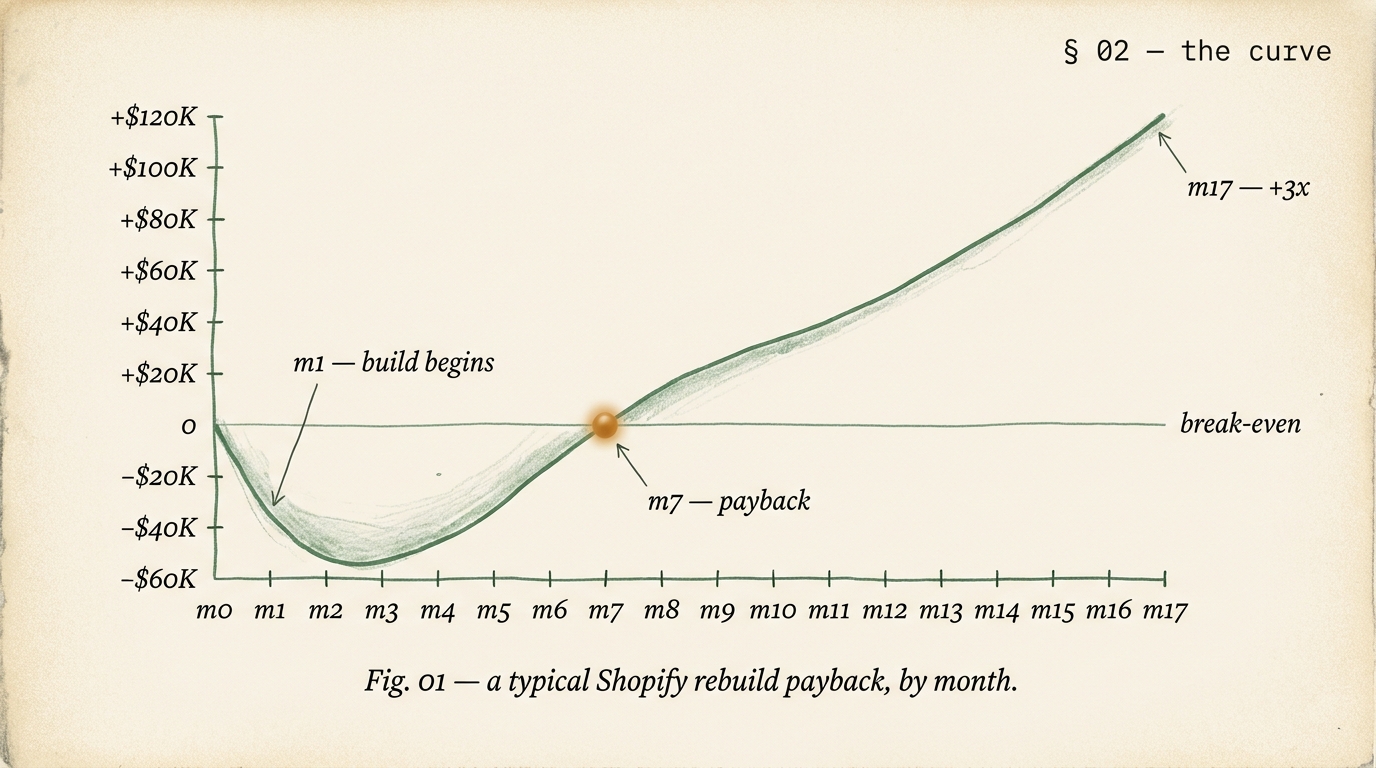
Two sensitivity knobs move the payback window most. One, the conversion-rate lift assumption: every percentage point of conversion-rate improvement on a $1.5M GMV store is roughly $15K of incremental annual revenue. Two, the build cost itself: a $120K build at a 14 percent combined lift pays back in roughly 6 months; a $240K build at the same lift pays back in roughly 12 months. If you are modeling a rebuild and the payback month sits above 18, the right conversation is usually about reducing build scope, not about finding more lift.
The third factor, not shown in this calculator, is the compounding effect of a better platform on future work. Brands on well-built Shopify Plus ship merchandising changes 3-5x faster than brands on legacy platforms, which means marketing experiments compound across the platform lifespan. We do not model that here because it is hard to attribute, but it is real.
Five answers.
What conversion-lift should I assume for a Shopify rebuild?
The most common pre-to-post lift we see on rebuilds from legacy platforms (Magento, WooCommerce pagebuilder, custom carts) to modern Shopify Plus is between 8 and 22 percent, with a median around 14 percent. Lifts are larger when the pre-rebuild site has poor Core Web Vitals (LCP above 4 seconds, INP above 300ms) and smaller when the pre-rebuild site is already on a fast modern stack. Assume 10-15 percent for a reasonable estimate; 20 percent plus is optimistic.
What AOV-lift is reasonable?
AOV lift comes from three levers: better upsell and cross-sell surfaces, cleaner bundle merchandising, and Shop Pay's faster checkout reducing abandonment at the high-AOV tail. Typical AOV lift is 5 to 12 percent post-rebuild, with median around 7 percent. If you are also shipping a subscription tier or a loyalty program as part of the rebuild, the AOV lift can be higher due to reorder frequency, but model those as separate lines.
What build cost should I expect?
For a mid-market Shopify Plus rebuild (migration from Magento or WooCommerce, custom theme, Checkout Extensibility, apps configured, 1 subscription tier, full content migration), budget $80K to $180K. Simpler brand-only Shopify rebuilds run $40K to $85K. Headless Hydrogen or Next.js rebuilds run $120K to $280K. Put your best estimate into the calculator; it will tell you whether the payback window makes sense at that number.
When does a Shopify rebuild not pay back?
Three common cases. One, you are at $200K/year GMV and the build cost is $80K; the payback window is too long relative to brand-survival horizon. Two, you are already on a well-built modern stack and the marginal lift from a rebuild is under 5 percent; spend the budget on acquisition or product instead. Three, the rebuild is cosmetic only (no real UX, performance, or merchandising changes); the lift will not materialize.
Does this calculator factor in contribution margin?
No, it computes on revenue. For a true ROI-to-profit model, multiply the calculated incremental revenue by your contribution margin percentage (see our profit calculator). For most DTC brands, contribution margin is 35-55 percent, so the true contribution return is roughly half the revenue return shown here.
Ready for a real scope + quote?
Our Shopify audit ships in 2 weeks. Current-state assessment, realistic lift targets, scoped build quote. Refundable against the engagement.