Blended CAC calculator. Past the vendor dashboards.
Meta says one CAC, Google says another, neither includes email tools, creator fees, or organic overhead. This calculator sums everything and divides by real new-customer count.
Sum everything acquisition-related.
True blended CAC.
Everything in, divided by one thing.
Blended CAC is the most honest acquisition number a DTC brand can track because it cannot be gamed by channel attribution. Meta's reported CAC drops when Meta's attribution window captures more credit; Google's reported CAC drops when Google's attribution window captures more credit; no amount of dashboard manipulation moves blended CAC because the denominator (new customers) is the same across the company.
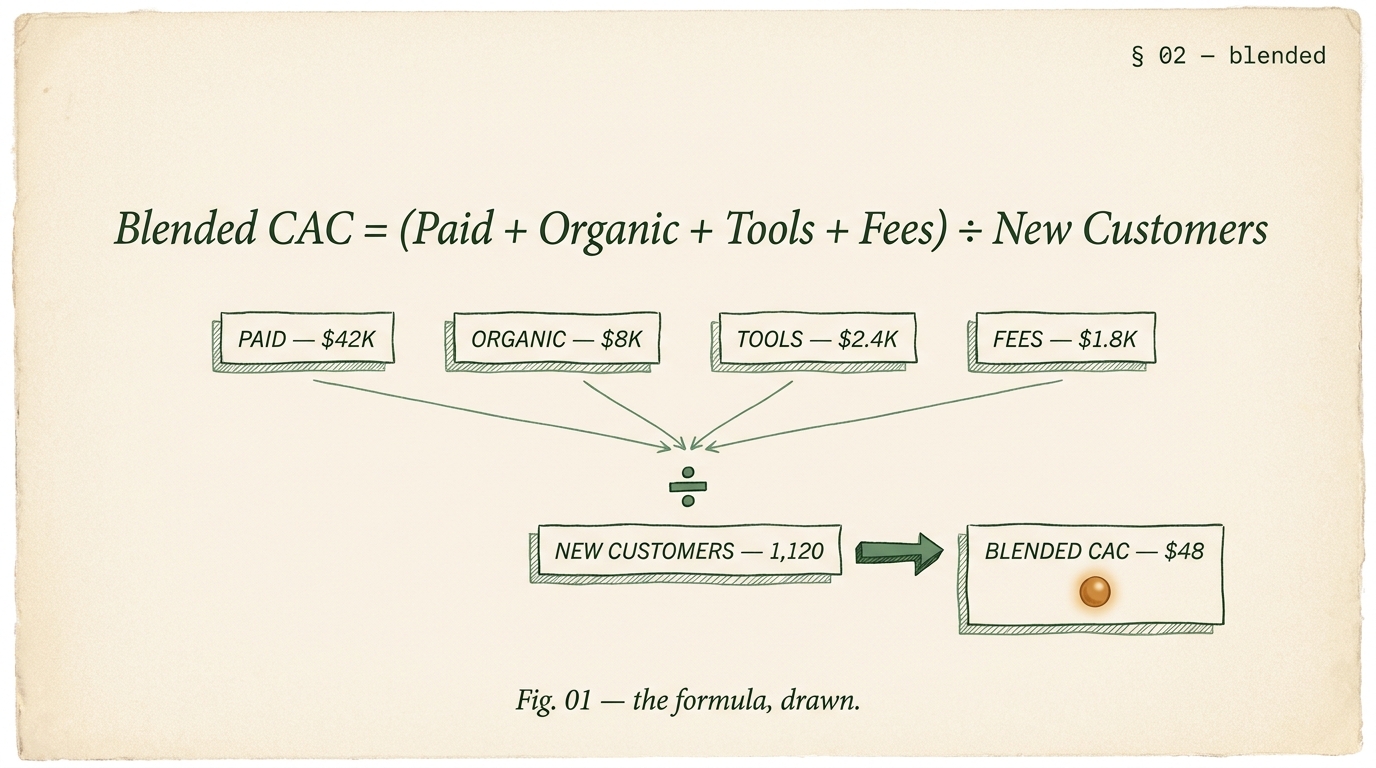
The most common place brands get blended CAC wrong is in the "organic operations" line. A content team costs money. An SEO tool costs money. A founder's time on creator partnerships costs money (even if the founder is not drawing salary). If the blended CAC calculation includes only paid ad spend and divides by new customers, the number is flattering by 20-40 percent for most brands. Include everything acquisition-adjacent.
The second place it goes wrong is in the customer-count denominator. "New customers" means first-time purchasers only, not total orders. If a customer ordered three times in the period, they count as one. If you mix new and repeat, you get blended CPO (cost per order), which is a different number serving a different purpose. Keep the two apart.
Five answers.
What is blended CAC?
Blended CAC is total acquisition-related spend (every channel, every tool, every fee) divided by total net-new customers. Unlike channel CAC (Meta CAC or Google CAC), blended CAC captures the full cost of new-customer acquisition and cannot be gamed by shifting credit between channels. It is the number that actually determines whether the unit economics work.
Why does my Meta-reported CAC differ from my real CAC?
Three reasons. One, Meta's attribution credits the last ad click inside its own tracking window, missing conversions driven by other channels. Two, Meta excludes channel costs like email tools, creator fees, and affiliate payouts. Three, post-iOS 18, Meta's reported conversions are systematically under-counted for iOS Safari users, which skews reported CAC downward on actual spend but upward on reported conversions. Blended CAC bypasses all three problems.
What should I include in 'organic operations cost'?
Any internal cost attributable to acquisition that is not paid ad spend. That includes: content team salaries allocated to acquisition content, SEO tooling, organic-social tooling, PR retainers, influencer gifting (not paid placement), and founder/team time if you are a small team and want true cost visibility. Most DTC brands underestimate this by 30-50 percent.
What's a healthy blended CAC?
The right frame is blended CAC as a multiple of AOV or as a fraction of LTV, not in absolute dollars. Healthy brands typically run blended CAC at 0.3-0.5x of AOV (first-order pays for itself) and at 0.25-0.4x of 12-month LTV. If your blended CAC exceeds AOV, you need contribution margin + repeat-purchase behavior to carry the acquisition cost.
How does blended CAC relate to MER?
MER (Marketing Efficiency Ratio) is total revenue divided by total marketing spend. Blended CAC is total marketing spend divided by new customers. They're two views of the same data. MER measures revenue efficiency; blended CAC measures acquisition efficiency. Most operators we work with track both weekly and prefer MER for ad-spend decisions and blended CAC for hiring and strategic decisions.
Seeing a blended CAC problem?
Our paid acquisition engagements start with a CAC + MER + LTV diagnostic week. Scoped quote in 48 hours.