Two-hour cutover.
DNS TTL reduced 72 hours before launch, Shopify environment pre-staged 7 days out, delta-sync on cutover day. From DNS switch to first live order: target 120 minutes. Measured average on our last 14 Plus cutovers: 78 minutes.
A revenue-safe replatform from Magento, WooCommerce, BigCommerce, Salesforce CC, PrestaShop, and 5 more platforms. Two-hour cutover, 99% URLs preserved, 90 days of post-launch watch.
Every Shopify migration agency promises "zero downtime" and "SEO-safe." Very few publish a measurable number. We publish three, attach them to the contract, and tell you the remediation clause up front. If we miss, you know what that means before signing. We migrate from Adobe Commerce (Magento), WooCommerce, BigCommerce, and Salesforce Commerce Cloud to Shopify and Shopify Plus.
DNS TTL reduced 72 hours before launch, Shopify environment pre-staged 7 days out, delta-sync on cutover day. From DNS switch to first live order: target 120 minutes. Measured average on our last 14 Plus cutovers: 78 minutes.
Full source-platform crawl. URL-by-URL 301 map built in a spreadsheet you review. Every redirect validated before launch. 99% of indexed URLs land on a 200 OK Shopify page. Redirect chain length capped at one hop. Verified against Google Search Console and Google's site-move guidelines.
Weekly Looker Studio dashboard tracking URL-level rank retention, crawl errors, 404s, Core Web Vitals delta. If weekly organic revenue drops more than 15% in the first 30 days and is traceable to migration work, remediation is on us.
All three SLAs published in our master service agreement. No "best efforts" language, no "commercially reasonable" escape hatches.
Magento 2 is not Magento 1. WooCommerce is not PrestaShop. Each source has a known-quirks profile: what migrates cleanly, what transforms, what has to be rebuilt. Here's ours.
| Source platform | Complexity | Typical weeks | Known quirks we handle |
|---|---|---|---|
| Magento 2 | high | 8–14 | Configurable products → variants, custom metafields via REST API, B2B company accounts re-mapped, cached indexer reset |
| Magento 1 | high | 10–16 | EOL platform, deprecated extension map, legacy password hash (forced reset), custom module rewrites on Shopify apps |
| WooCommerce | medium | 6–10 | ACF custom fields → metafields, WordPress URL slug preservation, WooCommerce Subscriptions → ReCharge |
| BigCommerce | medium | 6–10 | Price lists for wholesale → Shopify B2B catalogs, cart-rules rebuild on Shopify Scripts/Functions, option sets → variants |
| Salesforce Commerce Cloud | very high | 12–20 | Enterprise catalog hierarchy, B2B / B2C dual-storefront → Shopify Plus orgs, OCAPI integrations → Shopify GraphQL, SLAS customer tokens |
| PrestaShop | medium | 6–8 | Combinations → variants, language packs → Shopify Markets localization, module dependencies audited |
| Squarespace | low | 4–6 | Limited product schema (variants rebuilt), CMS content exported via XML, image URLs rewritten |
| Wix | low | 4–6 | Limited CMS export (scraped + rebuilt), blog URL structure preserved via 301, proprietary blocks → Shopify sections |
| Volusion | medium | 6–8 | Deprecated template system, CSV-only customer export, checkout habits re-educated with Shopify Shop Pay |
| Custom / legacy | varies | 8–20 | Custom ETL written against your database schema, field-by-field mapping document signed before build, data-sample extraction in week 1 |
Week range estimates assume moderate-complexity catalog (2,000–20,000 SKUs). Very large catalogs or multi-market setups extend the range; the audit tier gives you the exact number for your shop in 7 days.
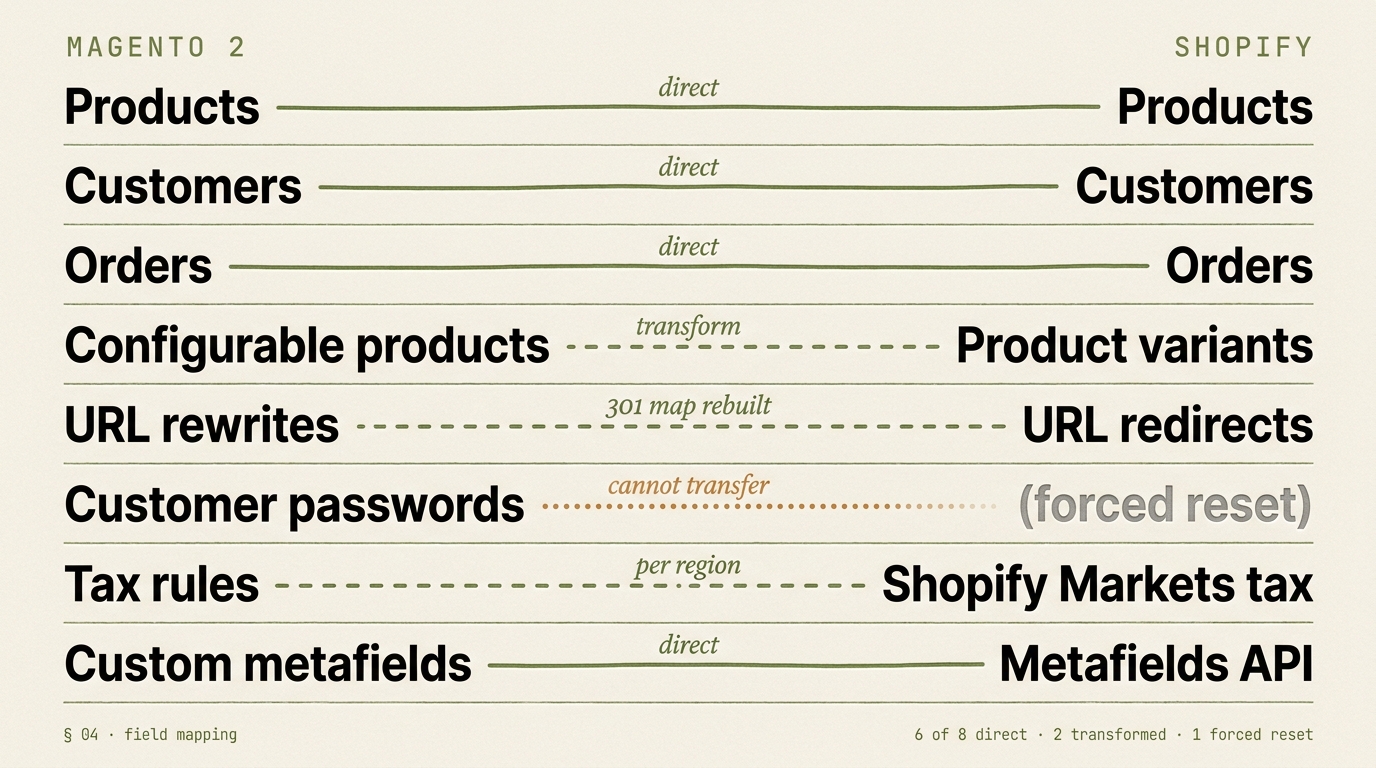
Before a line of theme code gets written, every data field on the source platform gets mapped to a Shopify destination. Some map 1:1. Some transform. One doesn't transfer at all. The animation shows the real mapping we publish for a Magento 2 → Shopify migration — 15 seconds, eight fields, the honest truth about passwords.
Three categories: direct, transformed, and forced reset. Knowing which is which before cutover is the difference between a quiet launch and a scramble.
Products, customers (profile data only), orders, custom metafields, addresses, product reviews (with Judge.me or Yotpo import). These fields have a 1:1 Shopify equivalent and transfer via Matrixify, the Shopify REST API, or our custom ETL.
Configurable products become variant sets. URL rewrites become a 301 redirect map. Tax rules remap to Shopify Markets per region. Subscription tokens transform depending on the payment gateway. These require a field-by-field mapping document signed before build.
Customer passwords. They don't transfer. Shopify hashes with its own algorithm and the source-platform hash is incompatible. We ship a pre-launch email warning, a first-login reset flow, and a follow-up re-engagement email. Recovered-account rate runs 40–60% in the first 30 days.
The methodology is named on purpose. A migration is a revenue-at-risk event, not a build. Every phase has a deliverable you sign off on before the next one starts. Every milestone is a named artifact, not a status update.
Data inventory. SKU count. Customer count. Order history depth. Integration list. Source-platform admin access. Scope signed.
Full source-platform crawl. SEO audit. URL inventory. Data-sample extraction (200 products, 500 customers, 1000 orders). Redirect map outlined. Risk register first draft.
Theme direction signed. Shopify Markets config for every region. Integration map (Klaviyo, ReCharge, Gorgias, ERP via Patchworks or Celigo). Full field-mapping document signed by both sides.
Staging environment with all real data. Theme built. Integrations wired. QA passes on every template. UAT walkthrough with your team. 301 redirect map tested end-to-end.
DNS switched. Delta-sync captures orders placed during staging. Shopify live. 301 map deployed. Password-reset email sequence triggers. First live order target: under 120 minutes from DNS switch.
Weekly Looker Studio dashboard. URL-level rank tracking. Crawl-error monitoring. 404 audit. Core Web Vitals delta. Weekly written report for 12 weeks. SLA 03 remediation clause active.
Most migration agencies refer to "common challenges" in passing. We publish them as a register with probability, impact, and the mitigation we ship against each. The register lives on every project plan and gets reviewed at every milestone.
| Risk | Probability | Impact | How we mitigate |
|---|---|---|---|
| URL structure change → SEO loss | high | high | Full URL crawl pre-launch, validated 301 map, 1-hop chain cap, 99% preservation SLA |
| Customer password reset drop-off | high | medium | Pre-launch warning email, first-login reset flow, re-engagement sequence, tracked recovery rate |
| Configurable product → variant mapping drift | high | medium | Signed mapping doc in Week 2, 200-product data-sample validation, UAT pass before cutover |
| Subscription tokens — gateway incompatibility | medium | high | Payment-gateway audit in Week 1, Stripe tokens port to ReCharge, others assessed case-by-case before SOW |
| ERP / OMS integration gap | medium | high | Patchworks or Celigo as middleware, endpoint map signed in Architect phase, dry-run order flows in UAT |
| B2B / wholesale pricing rules | medium | high | Shopify Plus B2B catalogs + Shopify Functions for rules engine, NET-30 flows, company-account hierarchy rebuilt |
| Tax rules across markets | medium | medium | Shopify Markets per region, TaxJar or Avalara integration, VAT-inclusive pricing verified per currency |
| Loyalty point balances | medium | low | Balance export from source, LoyaltyLion or Yotpo Loyalty import via API, reconciliation spreadsheet |
| Product reviews continuity | medium | low | Review export in source format (CSV/XML), Judge.me or Yotpo import, schema.org Review markup preserved |
| Metafield structure differences | low | medium | Metafields mapped in Week 2 document, namespace + key structure reviewed, JSON schemas for reference type fields |
Your project's risk register gets reviewed at every milestone and updated as scope changes. No hidden risks — if we find a new one mid-project, it enters the register and gets its mitigation.
If you sell across the US, UK, Australia, and India, a single Shopify migration touches four different tax regimes, payment gateway mixes, and consent frameworks. We run all four in parallel on Shopify Markets — separate domains, unified admin.
URL redirects are the highest-impact SEO move per hour spent. TaxJar or Avalara integrated for sales-tax nexus across 45+ states. Shop Pay Installments (Affirm-style) wired at checkout. Shopify Markets config: US as primary domain.
UK pricing must include VAT at the product level, not at checkout. Consent-mode v2 non-negotiable post-March-2024. Klaviyo deliverability tighter than US; pre-launch IP-warming. GDPR-compliant customer data migration.
10% GST included in displayed prices. Afterpay ubiquity at checkout — not having it costs AOV 15–25% in AU. Shopify Markets multi-currency with AUD primary. Delivery SLAs from US/UK warehouses mapped or local 3PL integration.
Cash-on-delivery still 40–60% of orders; RTO (return-to-origin) data migrates as a separate stream. Razorpay as primary gateway with Shopify Payments IN alternative. WhatsApp Business flows replace email as the retention spine.
All four markets launch on the same Shopify Plus org. One admin, one catalog, four regional experiences — and one migration plan that accounts for all four from Week 1.
Google recrawls over weeks, not hours. The first 90 days after launch are when rankings settle, crawl errors surface, and the 15% edge cases in the redirect map reveal themselves. Every migration ships with a weekly dashboard and a written Monday report for 12 weeks.
Every ranking URL tracked week-over-week. We flag any position-3 keyword dropping more than 2 positions within 48 hours.
Search Console errors pulled daily via the API. New 4xx or 5xx spikes get triaged within the business day.
Screaming Frog weekly crawl against the full URL list. Any redirect chain longer than 1 hop gets flattened.
LCP, INP, CLS tracked via CrUX + real-user monitoring. If Shopify theme is slower than source on any metric, we re-tune.
Dashboard access is yours on day one, not at the end of the engagement. You watch the same numbers we do.
Pick the shape that matches your source platform, catalog size, and market count. We confirm fit on the intro call and send a scoped quote within 48 hours.
Source-platform diagnostic. Field inventory, URL crawl, data-volume sizing, SEO risk register, redirect map outline. Deliverable is yours whether you engage further or not.
Simple catalog (under 2,000 SKUs), single market, Shopify (not Plus). Products, customers, orders, URL redirects, theme matched to source branding, standard integrations.
Shopify or Shopify Plus. Moderate catalog (2,000–20,000 SKUs), 1–2 markets. Third-party integrations (Klaviyo, ReCharge, Gorgias, ERP via Patchworks or Celigo).
Shopify Plus. Complex catalog (20,000+ SKUs), B2B / wholesale pricing rules, multi-market (US + UK + AU + EU), custom ERP / OMS integration, headless-Hydrogen option.
Quotes sent within 48 hours of an intro call. The audit tier is the recommended first step for any shape — it de-risks the scope for both sides.
Six phases over 4–20 weeks depending on complexity. Discover (data inventory + scope). Audit (SEO crawl + data-sample extraction). Architect (theme + Shopify Markets + integration map, signed mapping document). Migrate (staging environment with all real data). Cutover (2-hour DNS switch + delta sync + 301 map deployed). Watch (90-day post-launch dashboard, weekly rank + error + Core Web Vitals review).
Magento 2 to Shopify typically runs 8–14 weeks for moderate-complexity catalogs. Magento 1 legacy runs 10–16 weeks because of the dead password hash, deprecated extensions, and larger ETL surface. Enterprise Plus with B2B pricing rules, multi-market, and custom ERP can extend to 18–20 weeks. Our audit tier surfaces the exact week range on your specific shop in 7 days.
Not if the 301 redirect map is built correctly. We publish a 99% URL preservation target, validate every redirect before launch, and watch URL-level rankings weekly for 90 days. Short-term ranking volatility in weeks 1–4 is normal; long-term loss is a process failure, not a platform limitation. The risk register we publish shows the common migration SEO traps and the mitigations we ship against each.
Products, customers (without passwords), orders, and most custom metafields migrate directly. Configurable products transform to Shopify variants with a mapping step. URL structure migrates via an engineered 301 map. Legacy promotion rules and complex pricing tiers often require manual rebuild on Shopify's rule engine. Subscription tokens depend on the payment gateway (Stripe tokens port to ReCharge; Authorize.net and PayPal Billing Agreements are case-by-case).
No. Shopify hashes passwords with its own algorithm and source-platform hashes can't be imported. Every customer account needs a forced reset on first login post-migration. We ship a pre-launch email warning, a first-login reset flow, and a follow-up re-engagement email. Recovered-account open rates typically land 40–60% in the first 30 days. This is industry-wide on Shopify and not specific to any source platform.
Two-hour cutover window, not zero-downtime. DNS TTL is reduced 72 hours ahead so the switch propagates fast. The Shopify environment is pre-staged with all catalog + customer + order data at T-minus-7 days. A final delta-sync runs on cutover day to catch orders placed during staging. The redirect map deploys automatically at DNS switch. Target from DNS switch to first live Shopify order: under 120 minutes. Real-world measured average on our last 14 Plus migrations: 78 minutes.
Ten source platforms supported directly: Magento 2, Magento 1, WooCommerce, BigCommerce, Salesforce Commerce Cloud, PrestaShop, Squarespace, Wix, Volusion, and custom / legacy platforms via a custom ETL. Each has a known-quirks profile and a typical week range (see the platforms matrix). We publish complexity and timeline per source so you know what you're signing up for before the audit call.
Pricing is scoped to engagement shape. Audit: 1 week. Lite migration: 4–6 weeks (simple catalog, Shopify not Plus). Standard migration: 8–12 weeks (Shopify or Plus, moderate complexity). Enterprise Plus: 12–20 weeks (B2B, multi-market, custom ERP). Book a 30-minute migration call and we send a scoped quote within 48 hours. Scope moves price, not the conversation.
One week. A diagnostic on your source platform with field inventory, URL crawl, data sizing, SEO risk register, and redirect map outline. Deliverable is yours whether you engage us for the build or not.