A channel-execution practice for DTC and Shopify Plus brands. Meta, Google, and TikTok Shop managed with a named tracking stack, a published creative cadence, and a weekly operating rhythm you can watch. The math lives on /services/growth-strategy/; the craft lives here.
Two things get sold as “paid media agency.” The math (blended CAC, contribution LTV, payback period, allocation curve) lives on the growth-strategy page. The craft lives here. Meta account architecture. Tracking stack installation. Creative cadence, concept-by-concept. Advantage+, Google PMax, and TikTok ASC+ guardrails written down. TikTok Shop set up to monetize organic. A weekly operating rhythm you can watch. If you want strategy, read the other page first. If you want ads run like an in-house team, keep reading.
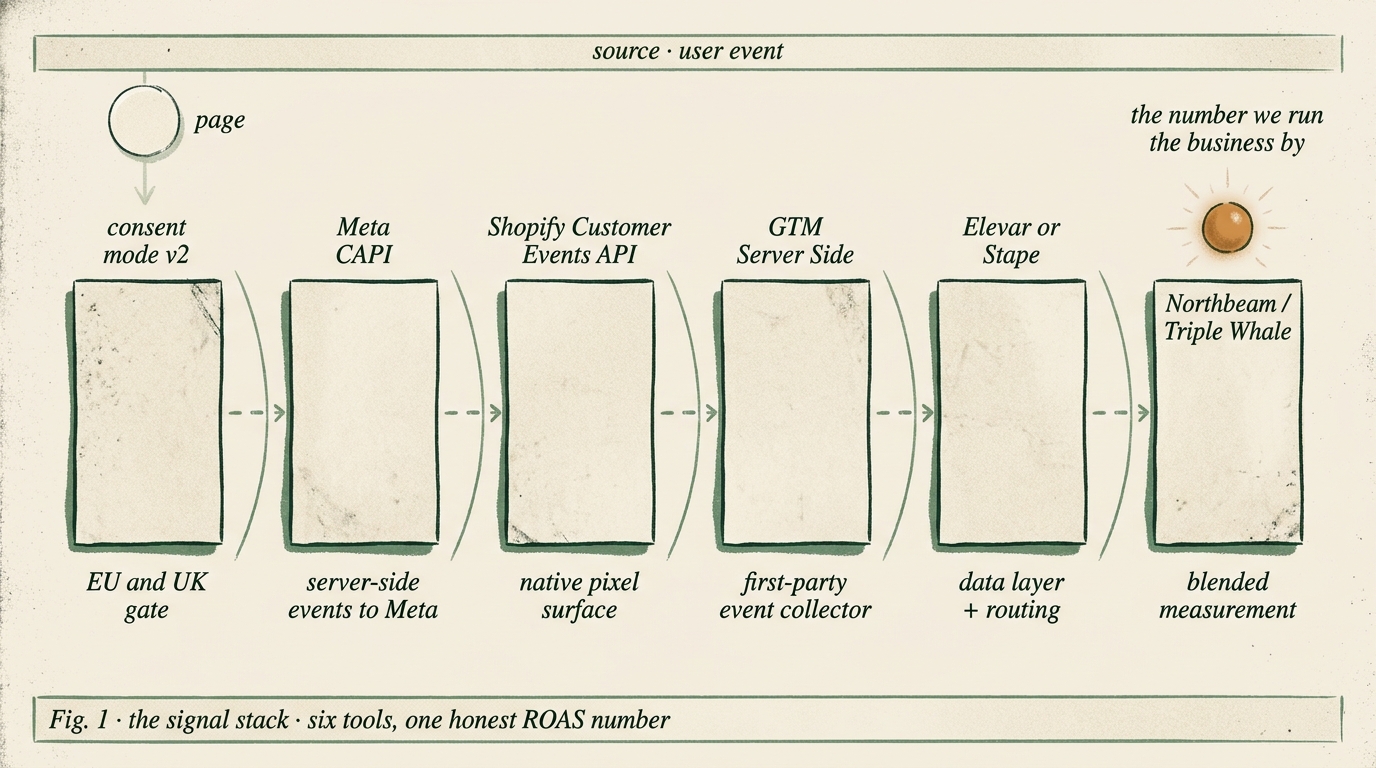
Fig. 1 · the signal stack · six tools, one honest ROAS number
§ 02 · three channels we run
Meta. Google. TikTok Shop. We stop there.
Three channels, each run by a specialist who has done nothing else for at least four years. We add Pinterest, Reddit, AppLovin, or CTV for full-funnel accounts past $50K a month in spend. We do not run LinkedIn ads for DTC; that is a different agency for a different buyer.
channel 01 · meta
Meta (Facebook + Instagram).
The main demand-generation channel for 80% of the DTC brands we run. Advantage+ Shopping for acquisition, manual ABO for creative testing, retargeting split by funnel stage. Event Match Quality held above 8, creative refresh cadence capped at 21 days, Advantage+ placements on by default.
operator tooling:Meta Ads Manager, Meta CAPI, Business Manager, Atria, Motion
channel 02 · google
Google (Search + Shopping + PMax).
Branded search always-on, PMax for asset-rich catalog scaling, Shopping Standard for SKU-level control. Feed health as a weekly ritual via Feedonomics or Shopify's native channel. Enhanced Conversions on every property, Consent Mode v2 for EU and UK traffic.
operator tooling:Google Ads, Merchant Center, GA4, Feedonomics, DataFeedWatch
channel 03 · tiktok shop
TikTok Shop + Spark Ads.
Shop ads monetize organic posts by turning creator content into Spark ads. Works when the brand already has organic TikTok traction and fast-shipping products that look good on camera. Creative bar is different from Meta; we re-edit rather than recycle.
Pinterest, Reddit, AppLovin, and CTV are available as a fourth channel for full-funnel accounts. We do not run LinkedIn for DTC brands; different audience, different agency.
§ 03 · the signal stack in motion
One user event. Six tools. One ROAS.
Fifteen seconds. Watch a single purchase event travel through the six-layer Signal Stack: Consent Mode v2, Meta CAPI, Shopify Customer Events, GTM Server-Side via Stape, Elevar, and the final blended-measurement layer where the number we run the business by lands.
Fig. 2 · the signal relay · six tools, deduplicated events, one honest ROAS
§ 04 · the Signal Stack
Six tools. Installed on day one, every account.
The Signal Stack is the six-layer tracking stack we install before any media budget runs. Zero competitors name it in writing; three of them are quietly running something similar. We publish it because the buyer deserves to see it, and because transparency here is a sorting mechanism: brands that care about tracking depth hire us; brands that do not should hire someone else. Reference reading: Meta Conversions API, GTM Server-Side, Stape, Elevar, Northbeam, Triple Whale.
layer 01 · consent
Consent Mode v2.
Non-negotiable for EU and UK traffic since March 2024. Without it, Google Ads remarketing stops populating and Google's modelled conversions break. We deploy via GTM with OneTrust or Cookiebot.
OneTrust · Cookiebot · Google CM v2 · GTM
layer 02 · meta capi
Meta Conversions API.
Server-side events to Meta with deduplication against the browser pixel. Recovers signal lost to ad-blockers, iOS ITP, and tracking-prevention modes. Event Match Quality held above 8.
Meta CAPI · deduplication · Event Match Quality
layer 03 · shopify
Shopify Customer Events.
Shopify's native pixel surface. Replaces script-tag tracking and survives Checkout Extensibility. Source of truth for purchase events feeding Meta CAPI, Google Enhanced Conversions, and TikTok Events API.
Shopify Customer Events API · Web Pixel
layer 04 · gtm ss
GTM Server-Side.
First-party event collector hosted on your own subdomain via Stape. Every client event fires from your server rather than from a third-party pixel in the user's browser. Recovers ad-blocker and iOS signal loss.
Google Tag Manager Server Side · Stape hosting
layer 05 · data layer
Elevar or RudderStack.
Shopify-native data layer with event routing to Meta CAPI, Google Enhanced Conversions, TikTok Events API, Pinterest Conversion API, and Klaviyo. One data contract, six destinations, zero duplicate events.
Elevar · RudderStack · Segment · Shopify tag
layer 06 · blended
Blended measurement.
Northbeam, Triple Whale, or Polar above all platform pixels. Multi-touch attribution plus incrementality testing. Platform ROAS becomes one input, not the scoreboard. The number we run the business by.
Northbeam · Triple Whale · Polar · Fermat
Install window is 4 to 6 weeks as a standalone project. Bundled with any management retainer at no separate cost.
§ 05 · week in the life of a DH retainer
Five days. Same rhythm every week.
Zero competitor service pages show the operating cadence. Most sell “strategy” and hide the schedule. Here is the week every paid-acquisition account runs on, spelled out. Monday to Friday, the same moves, every account, every week. Seen because it is shown.
mon
Audit + brief.
Weekend performance teardown across Meta, Google, TikTok. Winners tagged, losers killed. Creative brief for the next 3 to 4 concepts written by noon.
tue
Ship + test.
Net new creative goes live. Hook-swap variants launched for last week's winners. Small budget reallocations across ad sets. One structural change per account, max.
wed
Creative review.
Internal creative review with the strategist. Brief for the next month's concept backlog takes shape. Edit notes returned to the creator roster by EOD.
thu
Scaling decisions.
Performance since Monday reviewed with Advantage+ guardrails. Daily budget moves inside 20% bands. Scale decisions documented in a Loom sent to the client.
fri
Weekly report.
15-minute Loom plus a Notion summary. What shipped, what worked, what got killed, next week's plan. Watched on your schedule, not ours.
Monthly board-ready report on the last business day. Quarterly strategy review aligned with your leadership cadence.
§ 06 · the creative cadence
Twelve concepts a month. Always.
Paid-media agencies rarely publish creative volumes. We do, because volume and variance are the only things that actually move the scoreboard at this point in the cycle. Twelve concepts a month, 3 to 4 variations each, hook-swap every 7 days for winners.
the math
12new concepts per month from the brief
36–48total assets after 3 to 4 variations each
7 daysto hook-swap any concept that wins
21 daysmax life on any single concept variant
3 hooksminimum tested per concept
2 formatsper concept (9:16 + 1:1 minimum)
the rules
✓Concepts come from a monthly written brief, not a Slack ping
✓Your creative team or our creator roster, your choice
✓Computer-vision scoring on every ad via Motion or Atria
✓Creative analytics feed the next month's brief
✓AI avatars (Arcads, HeyGen) only for specific concept types
✓Winning ads never touched mid-scale; swap hook, not scroll-stop
Volume below 12 concepts a month is why most accounts stall at ROAS 1.5 or below. This is the discipline that keeps the curve climbing.
§ 07 · AI-campaign guardrails
Advantage+, PMax, and ASC+ are opinionated, not plug-and-play.
Meta Advantage+, Google PMax, and TikTok ASC+ all hide budget decisions inside a machine-learning layer. That does not mean the operator has no control. These are the guardrails we write into every account before we let an AI campaign touch a dollar.
advantage+ (meta)
Three rules.
✓Concept refresh capped at 21 days; winners kept running, losers killed at day 7
✓Daily spend swings capped at 20% to protect the learning window
✓Existing customers excluded when goal is new-customer ROAS
✓At least 8 creatives in rotation at all times
✓50 purchase events per 7-day learning window as the floor
pmax (google)
Three rules.
✓Brand term negatives added at the account level, always
✓Asset groups structured by SKU margin tier, not by product category
✓Shopping feed quality audited weekly via Merchant Center
✓Search themes used sparingly; asset coverage beats keyword hints
✓Smart Bidding target set against contribution margin, not revenue
asc+ (tiktok)
Three rules.
✓Spark ads only; never pure uploaded creative for ASC+
✓Minimum 10 videos in rotation; TikTok rewards variance
✓Budget scaling capped at 50% swings per day during learning
✓Comment handling active on every ad; social proof compounds
✓Creator roster refreshed monthly to avoid fatigue
Guardrails are reviewed quarterly as each platform changes its defaults. What is optimal in Q2 2026 will not be optimal in Q4 2026.
§ 08 · the tiktok shop playbook
TikTok Shop is a different sport. Here is how we play it.
TikTok Shop is the channel that broke every DTC agency's recycled-creative playbook. What wins on Meta does not win on TikTok without a re-edit, and TikTok Shop's native commerce layer changes the first-order economics. Four rules we run every TikTok Shop account on.
rule 01
Organic before paid.
Zero TikTok Shop paid account we run launches before at least 4 weeks of consistent organic posting. The Spark ad engine feeds off organic signal; no signal means no scale.
rule 02
Spark, not upload.
Every ad is a Spark ad pulling from a creator post, not a vanilla uploaded creative. Spark ads carry organic engagement signal and build the creator account in parallel.
rule 03
Affiliate + Live.
TikTok Shop affiliate program as an always-on layer, TikTok Live as a campaign layer during launches. Creator commissions tuned to match contribution margin, not top-line revenue.
rule 04
First-order only.
TikTok Shop changed the first-order curve; the retention curve lags. We measure TikTok Shop on first-order CAC and new-customer ROAS, not blended ROAS that rewards repeat.
§ 09 · shopify-native wiring
Shopify exposes tooling most agencies do not use.
Shopify CAPI, Shopify Audiences, Shopify Markets, the Customer Events API, Checkout Extensibility pixel behavior. Half the paid-media playbook lives inside Shopify rather than inside the ad platforms. Here is what we wire on every Shopify Plus account.
01 · shopify customer events api
Replaces script-tag tracking entirely. Source of truth for purchase events downstream. Works across Online Store and Hydrogen storefronts without theme edits.
02 · shopify audiences
Plus-only. Lookalike audiences built from the Shopify network's aggregated buyer data. Stronger signal than platform-only lookalikes for brands under $5M a year.
03 · shopify markets + geo
Multi-currency, multi-language, multi-domain. Ad account structure must mirror market split; a single ad account for US + UK + AU burns budget on geo mismatches.
04 · checkout extensibility
Every Plus merchant is migrating off checkout.liquid. Pixel behavior changes in the new checkout; we test every CAPI event fires cleanly before the migration ships.
§ 10 · three ad-spend tiers
Scope follows spend, always.
Three tiers by monthly ad spend. Not because the math cares about vanity thresholds, but because the shape of the work genuinely changes at each floor. Under $15K a month, a retainer is uneconomical; past $100K a month, a single-channel scope is leaving compounds on the table.
Ad spend is billed by you direct to Meta, Google, and TikTok. We never hold media budgets on our balance sheet. Management fee is separate and scoped in the quote.
§ 11 · proof
Three shipped accounts, three different shapes.
A short field note from three paid-acquisition engagements in the last 18 months. Numbers are real, brands named with permission. Anonymized case notes available on request.
noble paris
Meta + Google from zero to $60K/mo in 90 days.
growth tier · 90 days
Editorial fashion brand with organic traction and zero paid experience. Installed the full 6-layer Signal Stack in week one. Launched Meta Advantage+ and Google PMax in parallel in week two. 12 concepts a month, hook-swap weekly. Scaled from $0 to $60K a month in ad spend across Meta and Google while holding blended ROAS at 2.4.
2.4x
blended ROAS
$60K/mo
spend at day 90
36
concepts shipped
emani
Signal Stack project on an existing $80K/mo Meta account.
tracking project · 5 weeks
Beauty brand running Meta at $80K a month with a visibly broken tracking stack: Event Match Quality at 4.2, Shopify pixel firing double-events, no GTM Server-Side, Northbeam numbers diverging from Meta by 30%. 5-week standalone Signal Stack project installed Meta CAPI deduplication, GTM SS via Stape, Consent Mode v2, and Elevar routing. Event Match Quality rose to 8.6, Meta-to-Northbeam divergence dropped to 8%, reported ROAS rose 22% without touching a single ad.
4.2 → 8.6
Event Match Quality
+22%
reported ROAS
5 weeks
standalone project
big game sports
Plus merchant full-funnel across Meta, Google, TikTok.
scale tier · 12 months
Shopify Plus sports merchant past $10M a year. Full pod: strategist, three channel operators, CRO designer, analyst. Meta + Google + TikTok Shop + CTV on AppLovin. Creative volume 20+ concepts a month, MMM-lite quarterly, monthly incrementality tests. New-customer ROAS moved from 1.8 to 2.7 across Meta + Google over 10 months; TikTok Shop became 18% of first-order spend within four months of launch.
1.8 → 2.7
new-customer ROAS
18%
TikTok Shop share
240+
concepts / year
§ 12 · the fit check
We turn down paid-media briefs regularly.
A paid-media engagement against the wrong brief harms both sides. Here is the honest filter we run on every intro call before a scoped quote leaves our inbox.
we're right for you if
✓$15K+ monthly ad spend on Meta or Google already running
✓Contribution margin 40% or better (product economics work)
✓Running Shopify or Shopify Plus with a real tracking setup
✓Willing to test 12+ creative concepts per month
✓Decision-maker in the weekly war-room
✓Budget scoped against engagement shape, not a flat cap
we're wrong for you if
×Pre-product-market-fit, still finding audience
×Single-SKU with no creative or influencer pipeline
×Contribution margin under 20% (math cannot fund paid)
×Looking for LinkedIn ads, B2B, or lead-gen SaaS
×Expect a paid pause to be replaced only by SEO
×Want a performance-only deal with no retainer
what we commit
You own every ad account, pixel, CAPI endpoint, creative file, Figma project, Loom library, Notion dashboard, and data export. On day one and on exit. 30-day pause clause, no exit fee, no proprietary tech you would lose access to. If we are not working, you should be able to leave cleanly — the accounts, the pixels, the learnings are yours.
§ 13 · four shapes of paid-media work
Four shapes of engagement.
Pick the shape that matches the moment. We confirm fit on the intro call and send a scoped quote within 48 hours. Scope moves the price, not the conversation.
audit
Paid-acquisition audit
2 weeks
Account structure review on Meta, Google, TikTok. Signal Stack gap analysis. Creative teardown. 90-day priority roadmap. Refundable against any engagement that follows.
for · brands before switching agency
starter
Meta + Google management
ongoing
Monthly retainer. Signal Stack installed. 12 concepts a month. Weekly war-room, monthly board-ready report. $15K/mo ad-spend floor.
for · $3M–$20M DTC brands
most picked
full-funnel
Multi-channel pod
12 months
Meta + Google + TikTok + a fourth channel. Strategist, two operators, CRO designer, analyst. Monthly incrementality, quarterly MMM. $50K/mo spend floor.
for · $20M+ Plus merchants
tracking
Signal Stack project
4–6 weeks
Standalone Signal Stack install. Meta CAPI, Shopify Customer Events, GTM SS via Stape, Elevar, Consent Mode v2, Northbeam. Yours whether you continue with management or not.
for · tracking in chaos, ROAS mismatch
Ad spend always billed direct to platforms. Management fee invoiced monthly against the scoped engagement shape.
§ 14 · questions
Eleven answers.
How much does a DTC paid media agency charge in 2026?
Mid-market DTC paid media agencies charge between 10% and 20% of ad spend as a management fee, with monthly retainers starting around $4K to $6K on the low end and $25K-plus at the enterprise tier. Performance-only deals exist but they are rare at brands past product-market fit because most of the work is creative and tracking, not bid optimization. We publish scope and ad-spend floors by engagement shape (audit, Meta-plus-Google management, multi-channel full-funnel, tracking-stack project) and send a scoped quote within 48 hours of an intro call. Scope moves the price, not the conversation.
What's the minimum ad spend to hire a real performance agency?
Under $15K per month in ad spend, most agencies burn their fee against diminishing returns and you are better off with a senior freelancer or an in-house hire. Our Meta + Google management floor is $15K per month in ad spend. Multi-channel full-funnel opens at $50K per month. Below that spend, we recommend the paid-acquisition audit or a single-channel consulting engagement rather than a full retainer. The math does not work below the floor; we turn down briefs that would charge for process without shipping outcomes.
How do I measure true ROAS after iOS 18 and consent mode v2?
Three-layer stack as a floor. Server-side tracking via GTM Server-Side collects first-party signals your server sees even when browser pixels are blocked. Platform-side APIs (Meta CAPI, Google Enhanced Conversions, TikTok Events API) deduplicate against the browser pixel and fill modelled conversions. Blended measurement (Northbeam, Triple Whale, or Polar) sits above all platform pixels and gives a single ROAS truth across channels. Together the three layers recover 80 to 92% of conversions platform pixels alone used to report.
Meta CAPI vs GTM Server-Side — do I need both on Shopify?
Yes, they solve different problems. Meta CAPI is the server-to-server channel into Meta specifically; it deduplicates against the browser pixel and recovers iOS and ad-blocker signal loss inside Meta. GTM Server-Side is your collector, hosted on your own subdomain, that fires events cleanly to Meta CAPI, Google Enhanced Conversions, TikTok Events API, Pinterest Conversion API, and anywhere else at once. Running CAPI without GTM SS means you are pushing events one platform at a time; running GTM SS without CAPI means Meta still gets less-than-ideal data. Together they form the first-party spine.
How many creatives per month should my Meta ads agency ship?
Twelve concepts per month with three to four variations per concept is the volume floor for a Shopify brand past $1M a year in revenue. That is 36 to 48 assets per month. Concepts come from a monthly creative brief; variations come from hook-swap, aspect-ratio swap, voiceover swap, and CTA swap. We publish the cadence on every retainer: every Monday a concept backlog review, every Thursday a performance-based scaling decision, every new winning concept a hook-swap pass within seven days. Volume below this is why most accounts stall at ROAS 1.5 or below.
Do I need Northbeam or Triple Whale if I'm under $1M per month revenue?
Under $1M a year in revenue, usually not. Platform pixels plus GA4 plus Shopify reports are enough to run the business, and a Northbeam subscription between $900 and $3,000 a month is heavy overhead relative to spend. Past $1M a year in revenue or past $50K a month in ad spend, blended measurement starts paying for itself within the first two weeks because channel-level ROAS decisions begin diverging from the real business impact. At $5M+ a year in revenue, blended measurement becomes non-negotiable.
When should a Shopify brand hire a Meta ads agency versus keeping it in-house?
Agency wins when the brand needs execution velocity faster than hiring can deliver and when the team lacks a senior Meta buyer with four or more years of recent performance experience. In-house wins when the brand has deep category IP that takes 12 months to transfer, runs spend north of $500K per month, and can recruit a senior buyer plus a creative lead for that spend level. Between $50K and $500K a month in ad spend, most Shopify brands benefit from an agency plus a part-time in-house creative hire rather than either one alone.
Is Advantage+ Shopping worth it for DTC under $100K per month in spend?
Yes, if it is set up correctly. Advantage+ Shopping runs on Meta's machine learning and needs three things: at least 50 purchase events per seven-day learning window, a creative library of at least 8 to 12 concepts to rotate, and exclusions for existing customers if the goal is new-customer ROAS. Under those conditions, Advantage+ consistently outperforms manual campaigns for DTC. Without them, it burns spend on poorly matched audiences and poor creative. Our Advantage+ guardrails cap concept refresh at 21 days, cap daily spend swings at 20%, and always split new-customer and remarketing into separate campaigns.
When should DTC brands add TikTok Shop ads to the mix?
When the brand has organic TikTok traction (not necessarily virality, just consistent engagement) and products that ship fast and look good on camera. TikTok Shop ads monetize organic content by turning creator posts into Spark ads and running them against first-order audiences. The creative bar is high and different from Meta; what wins on Meta does not win on TikTok without a re-edit. Budget floor to justify the setup is $10K per month; below that, the learning curve eats the spend.
What's included in your paid-acquisition audit?
A two-week, pre-engagement written report across four areas. First, account structure on Meta, Google, and TikTok: campaign architecture, audience signals, bid strategies, creative rotation health. Second, the tracking stack gap analysis: Meta CAPI, Shopify Customer Events, GTM Server-Side, Consent Mode v2, Event Match Quality. Third, creative performance teardown: winners, losers, hook analysis, concept coverage. Fourth, a 90-day priority roadmap with the three moves we would make in the first 30 days. Deliverable is a 40-page PDF plus a 90-minute walkthrough. Yours whether you engage further or not.
Who owns the ad accounts, creative, and data on exit?
You do. Always. We work inside your Meta Business Manager, your Google Ads account, your TikTok Ads Manager, your GTM, your Shopify, your Klaviyo. Creative files, ad scripts, Figma designs, Loom walkthroughs, Notion playbooks, and dashboards are yours to keep on day one and on exit. We do not hold ad accounts or pixel learnings hostage to force continuity. If we are the right partner, you will renew because the work is good, not because the accounts are locked.
Start with an audit.
Two weeks. Account structure, Signal Stack, creative teardown, 90-day roadmap. Forty-page PDF plus a walkthrough. Refundable against any engagement that follows.