Ecommerce profit calculator. Free. No signup.
Enter six numbers. See contribution margin, net profit, and margin percentage. No account, no email, no dashboard. Built by Digital Heroes for the founders we work with.
Enter your numbers.
Your profit shape.
Assumes flat revenue at your current monthly run-rate. Toggle a growth rate below to project.
Six line items. One number.
Profit is revenue minus six things. Four of them are variable (they grow with orders); two are fixed (they run whether you ship one order or ten thousand). The distinction matters because scaling ecommerce is always about growing contribution margin faster than fixed costs, which is why contribution-margin percentage is the number you want to watch quarter over quarter.
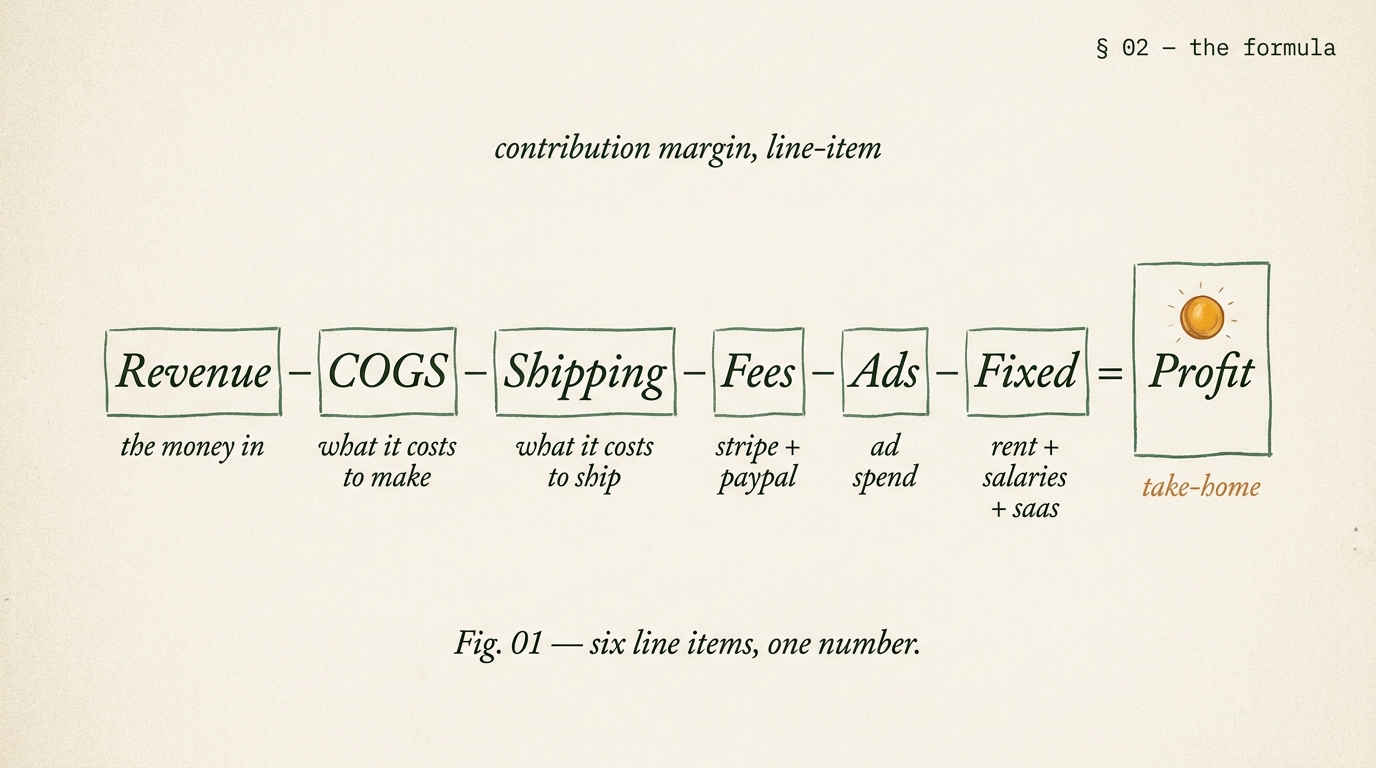
Contribution margin (revenue minus variable costs) is the number that scales. Net profit (contribution margin minus fixed) is the number that pays the founder. Most DTC brands that stall at $2M-$5M revenue have a contribution margin problem, not a fixed-cost problem. Their COGS is right, their shipping is right, their fees are right, and their ad spend is eating the contribution margin because blended CAC sits at 35-45 percent of revenue.
The usual fix is not cutting ad spend. The usual fix is a contribution-margin surgery: raise AOV with bundling, lift repeat rate with retention flows, and tighten CAC by re-segmenting the ad account. Each lever moves contribution margin by 2-5 percentage points. Stack three of them and the brand's net margin doubles without touching fixed costs.
Tools in this cluster that help: our Blended CAC calculator, our LTV calculator, and our Shopify ROI calculator. Each one takes a different cut of the same unit economics.
Five answers.
What is contribution margin?
Contribution margin is revenue minus variable costs (COGS, shipping, payment processing fees, ad spend). It tells you how much each order contributes to covering fixed costs before profit. For DTC brands the healthy contribution margin ranges from 35 percent (commodity categories) to 65 percent (premium or high-AOV brands). Below 30 percent, you are running a logistics business with a brand on top, and it is worth asking whether the unit economics can scale.
What should my target profit margin be?
By category. Fashion and apparel typically 8 to 15 percent net profit; beauty and cosmetics 12 to 25 percent; food and beverage 5 to 12 percent; home goods 10 to 20 percent; supplements and wellness 15 to 30 percent. Premium brands with strong pricing power run higher; commodity brands run lower. The more useful number is whether your margin is rising or falling quarter over quarter; direction matters more than the absolute level.
How do I lower my COGS percentage?
Three levers. One, negotiate with suppliers at higher volume (usually 8 to 15 percent savings at meaningful volume step-ups). Two, consolidate SKUs so you purchase fewer variants at higher volume each. Three, reduce shipping cost per unit by moving to regional 3PLs or absorbing fulfillment in-house past a certain order threshold. Raw material reductions are rare; the savings almost always come from consolidating volume and renegotiating.
Why is my ad spend showing such a big profit hit?
Because blended CAC usually absorbs 15 to 40 percent of revenue for DTC brands, and that is the biggest line item above COGS for most stores. If your ad spend is showing as a meaningful profit drag, look at contribution LTV (customer lifetime gross profit), not blended ROAS. A brand running at a 12-month payback CAC with 3x contribution LTV is healthy even if month-one profit looks thin.
Does this calculator save my data?
No. Every number lives in your browser only. Nothing is sent to a server. Close the tab and the data is gone. If you want to save a run for later, the Copy Results button copies a plain-text summary to your clipboard that you can paste into a doc.
Want help turning these numbers into a plan?
Our growth strategy engagements start with a unit-economics audit against the same numbers you just entered. Written plan in 2 weeks. Scoped quote in 48 hours.