Spend ÷ new customers.
Total marketing spend across paid, organic content, referral, affiliate, and influencer, divided by net new customers. Platform ROAS lies after iOS 18. Blended CAC is the only number that doesn't.
A DTC and Shopify growth practice that treats acquisition, retention, and attribution as four equations before it treats them as channels. Fractional or full-partnership, depending on the stage you're in.
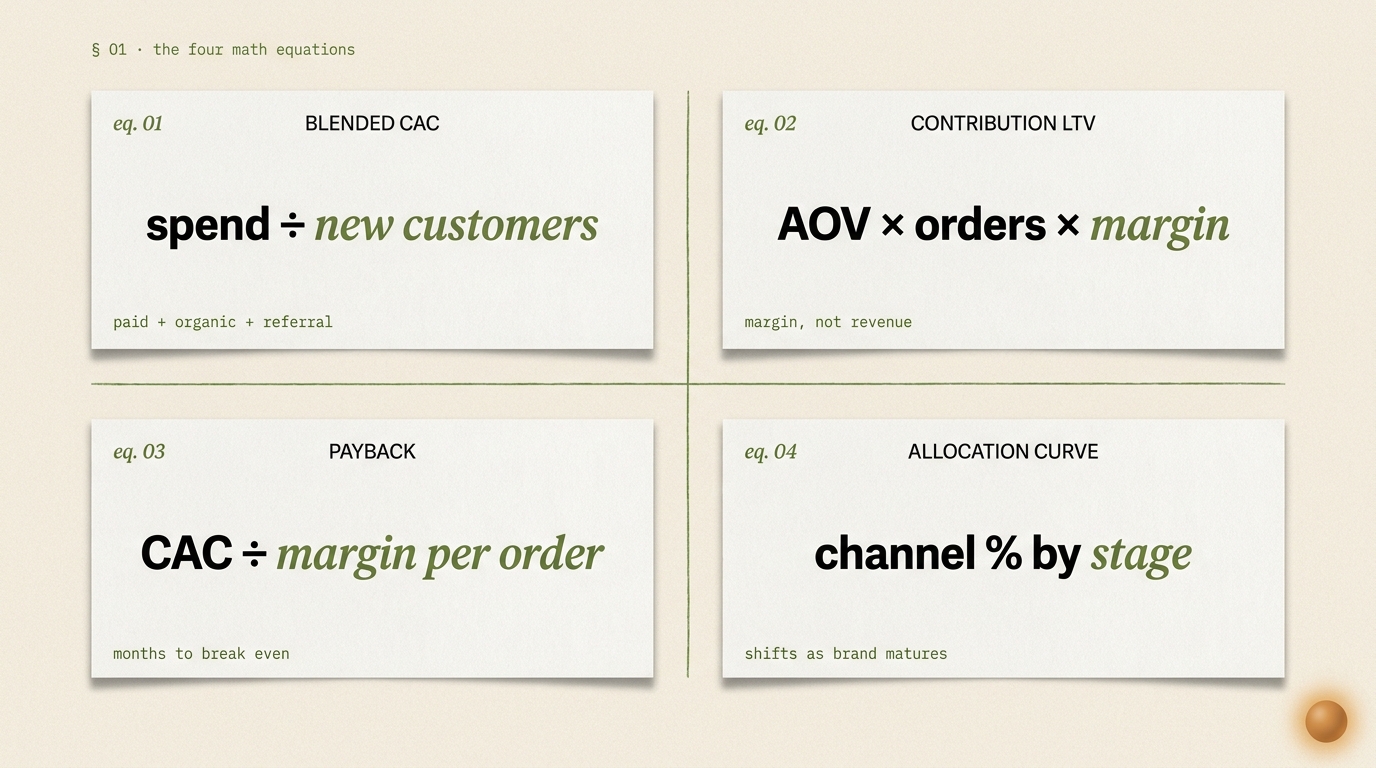
Every ecommerce growth agency talks about channels, funnels, and flywheels. The brands that actually compound don't start there. They start with four equations that together define whether the whole business model is fundable. Get these four right and channel choice follows. Skip them and no amount of creative will save the math. Every number on this page is measured against GA4, Northbeam, or Triple Whale, cross-checked against your Shopify reports and Klaviyo cohort data.
Total marketing spend across paid, organic content, referral, affiliate, and influencer, divided by net new customers. Platform ROAS lies after iOS 18. Blended CAC is the only number that doesn't.
Average order value, times orders per customer lifetime, times contribution margin. Revenue LTV flatters the deck. Contribution LTV is what actually funds the next cohort of acquisition.
Months to recover acquisition cost. Under three months is a scaling lane; three to nine is normal; longer than nine is a capital problem dressed up as a growth problem.
Paid social owns acquisition at launch; SEO, affiliate, email, and influencer compound at scale. The curve shifts deliberately as revenue grows. Misallocation kills more brands than low ROAS does.
Most brands overpay by picking the wrong delivery model, not the wrong firm. Fractional CMO, growth agency, and in-house team solve different constraints. We'll tell you which one fits, even when the answer isn't us.
| Fractional CMO | Growth Agency | In-House Team | |
|---|---|---|---|
| speed to ship | strategy in days, execution via vendors | pod running in 10–14 days | 60–120 days to hire + onboard |
| monthly cost | lower than a senior hire | mid-range, fully scoped | high + benefits + tooling |
| brand context depth | shallow first 60 days, deep after | moderate, improves per sprint | deepest, compounds over years |
| capacity | 8–12 hr/week leadership only | full execution pod | whatever you hire for |
| best for | $2M–$10M brands needing a senior voice | $5M–$50M brands shipping velocity | $20M+ brands with unique category depth |
| wins when | senior strategy, junior execution gap | capacity + craft > continuity | brand IP is the moat |
Between $2M and $20M, most brands benefit from fractional leadership plus an execution agency — two engagements, sometimes the same firm. We do both.
At $500K ARR, paid social does 70% of acquisition work. At $50M ARR, paid social is under 30% and five other channels carry the rest. The animation shows how we re-balance the spend curve as the brand scales — 15 seconds, three stages.
Since iOS 14, and now harder since iOS 18 and the UK consent crackdown, platform pixels miss 30–60% of conversions. Meta tells you one ROAS, Google tells you another, the Shopify revenue doesn't match either. The fix is a layered stack, not a single tool.
GTM Server Side, Stape, or Segment as your first-party data collector. Every event fires from your server, not a third-party pixel in the user's browser. Recovers signal that ad-blockers and iOS ITP drop at the client.
Meta CAPI with deduplication, Google Enhanced Conversions, TikTok Events API. The platforms still model missing signal when you send them clean first-party events. Sending them nothing is sending them noise.
Non-negotiable for UK and EU traffic since March 2024. Without consent-mode v2, Google Ads remarketing audiences stop populating and reporting breaks. We deploy it via GTM with OneTrust or Cookiebot as the CMP layer.
Northbeam, Triple Whale, or Polar sitting above all the platform pixels. Multi-touch attribution plus incrementality testing. Platform ROAS becomes one input, not the scoreboard. The number we actually run the business by.
Together, the four layers recover 80–92% of conversions platform pixels used to report. Without them, the entire growth model runs on bad data.
Creative velocity, variant generation, landing-page iteration, analysis — what used to take a pod of eight now takes a pod of three with an opinionated AI stack. Four layers, four decisions.
AI video avatars and ideation tools produce 40–80 creative concepts per week from one brief. Human strategist picks which 12 get shot.
One concept becomes 15 variants automatically — hook swap, voiceover swap, CTA swap, aspect ratio swap. Creative tests go from 2 per week to 20.
AI builds angle-matched landing pages in hours, not days. Headline + hero image + 3 proof blocks swap per ad concept. A/B tests on the page side, not just the ad side.
Computer-vision scoring of what actually wins. Hook length, face presence, pacing, colour density — measured, not guessed. Feeds next week's ideation brief.
Our stack is opinionated and it changes every six months. These are the picks we run in 2026-Q2.
We run brands across the US, UK, Australia, and India. Same Shopify stack, four different acquisition physics. If your growth agency only operates in one of them, you'll hit the wall when you expand.
Meta and Google CPMs at cycle highs. Blended ROAS below 2.0 for most categories. TikTok Shop changed the first-order curve but not the retention one. The only edge left is creative velocity and brand search.
Consent-mode v2 enforced, iOS share near 55%, VAT included pricing changes the AOV calculation. Klaviyo deliverability tighter than the US. Influencer-led acquisition punches above its weight vs paid.
Small addressable audience, high AOVs, strong influencer economy, CPMs 20–30% below the US. Afterpay ubiquity shifts conversion and AOV math. The category leader often is just the most consistent Meta account.
Cash-on-delivery still 40–60% of orders; RTO management is the real margin battle. WhatsApp Business flows outperform email 3–5× on retention. Meta dominates acquisition; Google pays off mostly on branded search.
Most growth agencies live on the acquisition side of the equation. That's half the work. The retention side — subscription design, post-purchase flows, 2nd-order CAC, SMS economics — is the half that makes the first half fundable.
Recharge for scale, Smartrr for brand-forward members-club models, Shopify native for simplicity. The choice defines churn curves and LTV. Picking wrong costs 15–25% of LTV within year one.
Seven flows that should exist day one: welcome, abandoned cart, abandoned checkout, browse abandoned, post-purchase, win-back, VIP. Each one has a revenue-per-recipient target. If they don't, they're decoration.
What does it cost to generate the second purchase? An underused metric. When 2nd-order CAC is a fraction of 1st-order CAC, retention is real. When it's similar, the brand is churning and replacing, not retaining.
Postscript or Attentive. Much higher revenue-per-message than email, much easier to overuse. One flow per campaign, two campaigns per month max. The discipline is what makes it work.
Growth strategy costs the same to deliver whether the math works or not. When the math doesn't work, the project harms both sides. Here's our honest filter.
You own every ad account, pixel, CAPI endpoint, creative file, Figma project, dashboard, and data export. On day one and on exit. 30-day pause clause, no exit fee, no proprietary tech you'd lose access to. If we're not working, you should be able to leave cleanly.
Pick the shape that matches the moment. We'll confirm fit on the intro call and send a scoped quote within 48 hours.
Blended CAC audit, attribution readiness scorecard, channel allocation analysis, retention unit economics, 90-day priority roadmap. Deliverable is yours whether you engage further or not.
8–12 hours per week sitting alongside your team. Weekly operating rhythm, monthly board-ready reporting, hands-on execution on the two highest-impact levers.
Dedicated pod: strategist, paid lead, creative lead, CRO designer, analyst. End-to-end ownership of blended CAC, creative velocity, landing-page testing, retention flows.
Server-side tracking setup, CAPI + Enhanced Conversions, consent-mode v2, Northbeam or Triple Whale configuration, post-iOS measurement playbook. Standalone project.
Quotes sent within 48 hours of an intro call. Ad spend is billed by you direct to the platforms; we never hold media budgets.
A system that answers four questions with numbers. What is our blended CAC across all channels? What is our contribution LTV after margin? How many months to recover CAC? What percentage of spend should sit in each channel at our current revenue stage? A growth agency that can't answer those four in 30 minutes is selling tactics, not strategy.
Fractional CMO wins when you need senior strategy but can't justify a $250K+ salary yet. Growth agency wins when you need execution capacity faster than you can hire. In-house wins when the brand has deep category knowledge that takes 18 months to transfer. Most brands between $2M and $20M ARR benefit from fractional leadership plus an execution agency — two different engagements, sometimes the same firm.
Pricing is scoped to engagement shape. Growth diagnostic: 2 weeks. Fractional growth leadership: 3–6 months at 8–12 hours per week. Full partnership: 12-month dedicated pod. Attribution readiness project: 4–6 weeks standalone. Book a 30-minute diagnostic call and we send a scoped quote within 48 hours. Scope moves price, not the conversation.
Four-layer stack. Server-side tracking via GTM Server Side or Stape for first-party signals. Meta CAPI and Google Enhanced Conversions for platform-level modelled conversions. Consent-mode v2 for EU and UK markets. Blended measurement in Northbeam or Triple Whale for the bigger picture. Each layer catches a different portion of the missing signal; together they recover 80–92% of what platform pixels used to report.
Our fit floor is $50K per month in revenue, 40%+ contribution margin, and verified product-market fit (repeat-purchase curve actually curves up). Below those, you need a product sprint, not growth spend. We turn down pre-PMF brands and single-SKU brands still finding audience — the work costs the same and the math doesn't work yet.
Attribution and diagnostic work surface insights inside week two. Creative velocity changes show in weeks three through six. Blended CAC improvements stabilise by month three. Retention flow uplifts compound over 90–180 days. Anyone promising a step-change in under 30 days is promising variance, not strategy.
You do. Always. We work inside your Meta Business Manager, your Google Ads account, your Klaviyo, your Shopify. Creative files, ad scripts, Figma designs, and dashboards are yours to keep on day one and on exit. We don't hold assets hostage to force continuity.
A 30-minute call to run the four equations on your numbers. You leave knowing which of the four engagement shapes fits your stage. We follow up with a scoped quote within 48 hours.