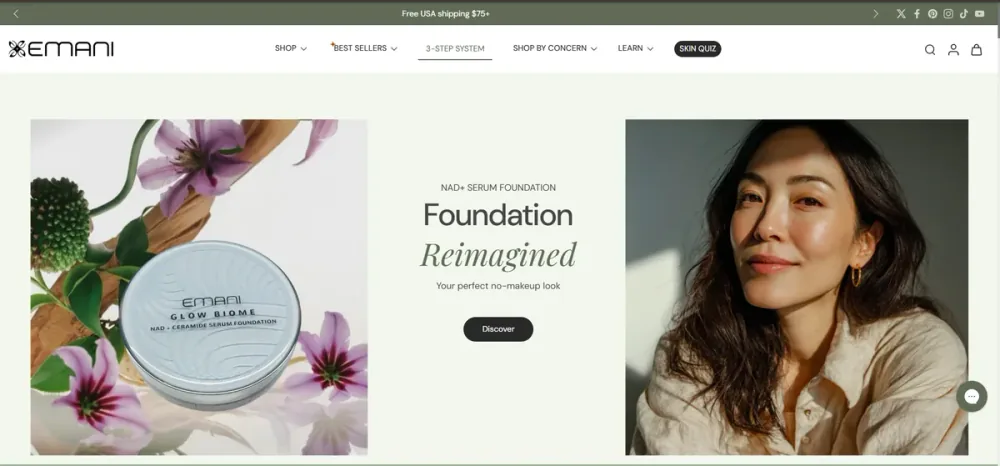
Emani · clean beauty
$2M/mo MRR
Shopify Plus rebuild. Headless front, OS 2.0 merchandising, subscription and bundle logic. 520% revenue growth year one.
Nine years, 2,000+ brands, three stores above $420K/month — custom themes, headless commerce, Shopify Plus, and checkout extensions engineered to Shopify's own standards.
A Shopify developer builds and customizes stores on the Shopify platform — using Liquid (Shopify's templating language), JavaScript, the Shopify Admin API, and Online Store 2.0. Not to be confused with a Shopify expert who handles setup, or an agency that just installs themes. A Shopify developer writes code.
In practice, we spend our hours on six things: custom theme sections and blocks, app integrations (ERP, subscription, reviews, loyalty), Shopify Plus checkout extensions, performance tuning to hit Core Web Vitals, store migrations from other platforms, and Flow automation for back-office workflows. Three in four engagements touch at least three of those.
The reason founders hire developers, not themes, is that off-the-shelf Shopify themes are built for the mass case. The merchandising logic that made your brand worth scaling — bundled gifts, subscriber-only pricing, a custom pre-order flow, a quote-to-cart for B2B — rarely fits. Theme customization is what bridges the gap. Headless commerce bridges it further.
Honest criteria. If the job passes this test, it's developer-worthy. If it doesn't, keep your money and use an app.
No hidden "senior" markup on juniors. The people on your build — from Liquid to Hydrogen — have shipped for brands you've bought from.
Custom sections, blocks, metaobjects, metafields, JSON templates, section groups, app blocks.
Remix-based Hydrogen storefronts, Oxygen deploys, Storefront API, server components.
Checkout extensions, Functions, Flow, Launchpad, Script Editor, B2B, Markets, expansion stores.
Remix + Polaris + App Bridge, Admin API, Storefront API, webhooks, GraphQL, BFCM-hardened.
NetSuite, SAP, Brightpearl, Cin7, ShipBob, ShipStation, Klaviyo, Recharge, Yotpo, Judge.me.
LCP < 2.5s, INP < 200ms, CLS < 0.1. We benchmark before Build and again at Launch.
Shopify Plus rebuild. Headless front, OS 2.0 merchandising, subscription and bundle logic. 520% revenue growth year one.

Custom Shopify theme with live-inventory feeds, team accounts, and a 4-step checkout extension that lifted completion 18%.

Editorial Shopify storefront, multi-currency Markets, limited-edition drop mechanic with queue-protected checkout.
Every engagement runs the same five acts. You always know which act you're in and what the next one looks like.
Brief, KPIs, brand voice, stack audit, content inventory.
Wireframes, visual system, PDP + PLP + checkout comps, prototype.
Liquid + JS, OS 2.0 sections, apps, content, Core Web Vitals pass.
QA matrix, staging sign-off, DNS cutover, post-launch monitoring.
A/B, cohort analysis, AOV lifts, monthly revenue review.
All three are real — no bait pricing. Senior-heavy delivery. Unused hours roll over. If we're not the right fit, we say so on the intro call.
20 senior Shopify hours. Same-week turnaround. Unused hours roll over up to 3 months. No project overhead.
DetailsSix weeks. Discover, Design, Build, Launch, Optimize. Theme, apps, content, migration, performance — all in.
Start a buildPlus migration, B2B, Markets, checkout extensions, Flow, multi-store, headless. 8–12 week timeline.
Plus engagement Upwork Top Rated+
 Trustpilot 4.9 ★
 DUNS 650878346
 UN Global Tier 1
Builds and customizes Shopify stores using Liquid, JavaScript, and the Shopify APIs — custom themes, Online Store 2.0 sections, app integrations, checkout extensions (on Shopify Plus), performance tuning, and Flow automation. We also handle migrations and headless Hydrogen builds.
Mid-market Shopify development runs $2,500 for a retainer sprint to $35,000+ for a Shopify Plus engagement. A standard custom store build (theme + integrations + content + launch) is $12,000–$25,000. Clear scopes before contracts — price moves only if scope does.
Yes. Digital Heroes is a Shopify Plus Partner, Upwork Top Rated Plus, DUNS Verified (No. 650878346), and a United Nations Global Marketplace Tier 1 Registered company. We build on Shopify, Shopify Plus, and headless Hydrogen.
Yes — full replatform migrations from WooCommerce, Magento, BigCommerce, Wix, Squarespace, Salesforce Commerce Cloud, and Etsy. Products, customers, orders, SEO redirects, theme, and checkout carry over with zero data loss and zero ranking loss, verified in Search Console post-launch.
Six weeks from brief to launch for a standard custom store. Discover (1 wk), Design (2 wk), Build (2 wk), Launch (0.5 wk), Optimize ongoing. Shopify Plus migrations and headless Hydrogen run 8–12 weeks depending on catalog and app surface area.
Dawn, Prestige, Impulse, Expanse, Be Yours, Sense, Stiletto, Broadcast, Studio, and 30+ premium themes. We also build from scratch on Online Store 2.0 when a brand needs logic off-the-shelf can't handle.
One business day. A senior Shopify developer reviews the ask, writes the plan, sends it back. If it's not a fit, we say so — and often point you to a better option.