Grain texture web design. Editorial tactility as the default.
Noise, film grain, and risograph mottling at 8 to 12 percent opacity over flat colour. Paper-feel surfaces. The signature DH ships on every page of this site.
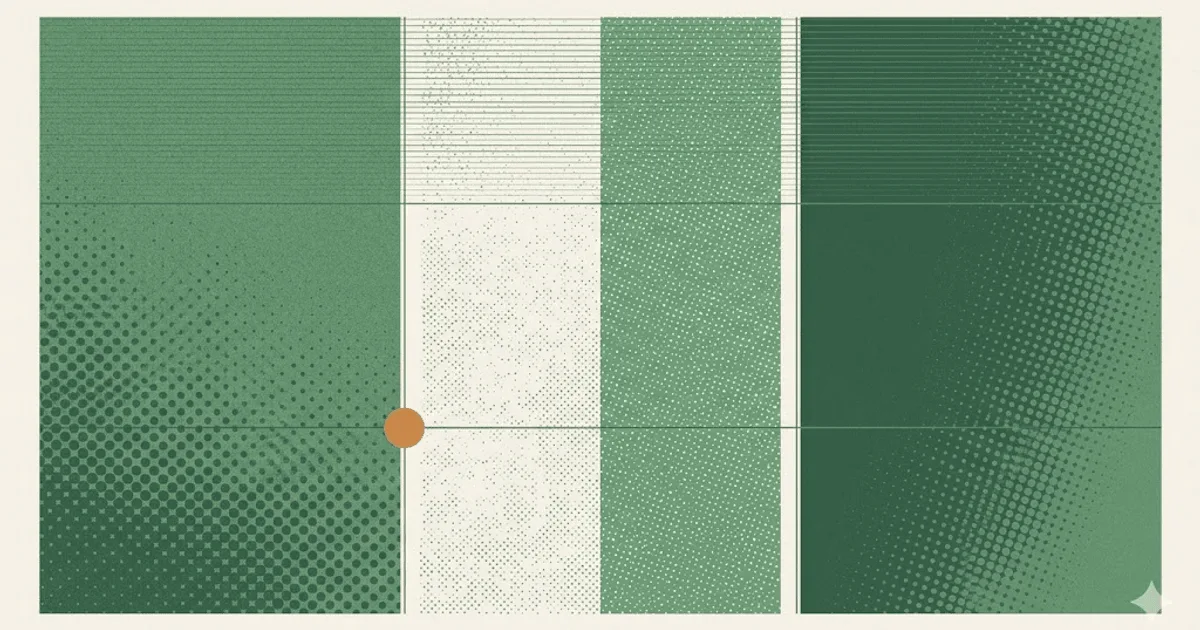
Noise, grain, and paper feel on a glass screen.
Grain texture web design is a fine pixel-stipple layer dropped over flat colour at 5 to 15 percent opacity with a multiply or overlay blend mode. It evokes film grain, paper fibre, or risograph print without dictating the underlying palette. The treatment replaces the sterile feel of pure flat design with editorial tactility, and it is the signature DH ships on every page of this site.
Flat design won the 2014 to 2020 era for one reason: it loaded fast and scaled cleanly. The cost was a decade of websites that all looked like the same Figma template. Around 2022 the discipline pushed back. Sites like Kinfolk and Ueno started layering visible film grain over their flat colour blocks. Studio sites followed. The treatment is now a default for editorial publications, indie design studios, and craft brands. It costs about 8 KB and one CSS rule.
The technique is mechanical. Generate fine random pixel noise with an SVG feTurbulence filter, or tile a small PNG of pre-baked grain. Layer it over the page at low opacity with mix-blend-mode multiply on light surfaces or overlay on dark. That single rule converts a sterile flat panel into something that reads like a printed page. The DH site uses 12 percent grain over cream paper in light mode and 40 percent over deep-space ink in dark mode. The recipe lives in one CSS file and renders before the first paint.
What grain is not: a colour palette, a typography choice, a layout system. Grain is a surface treatment. It pairs with any underlying design language, which is why brand identity systems increasingly ship grain as a separate token alongside colour, type, and motion. The brand chooses its palette; grain decides whether the palette reads as digital or as printed.
Five sites doing the work right now.
Grain texture lives across editorial publishers, design studios, and consumer tech brands. The five below are the cleanest current examples, each picked for a different reason. Read each as a tiny case study before borrowing.
-
editorial print, on the web
Kinfolk
Slow-living publication. Their digital editions carry the same paper grain as the print issues, layered over warm cream and ink-black. The grain reads as continuity with their twelve-year-old print archive.
-
studio site, craft-coded
Hand Cut Press by Stinkdigital
Award-winning case-study microsite for a stop-motion film. Heavy paper grain, hand-cut paper aesthetic translated to scroll. The grain is the entire visual language, not a layer on top of something else.
-
agency, mainstream-credible
Ueno
Independent digital agency, NY plus Reykjavik. Their site has carried a subtle film-grain overlay for years, and they apply the same treatment in client work for brands like Lyft and Airbnb. Proof that grain reads as premium, not folksy.
-
consumer tech, against the grain
Nothing
London consumer-electronics brand. Their site uses a dot-grain treatment rather than film grain, but the philosophy is the same: a flat colour panel becomes a textured surface. Notable as the first mainstream consumer tech brand to commit to grain.
-
community archive, craft-print
Risograph.net
Community resource for risograph printers and the studios using them. Worth reading because the digital grain you see on modern sites is a deliberate emulation of risograph mottling. Source-of-truth for the aesthetic.
Grain is an overlay. The palette is yours.
Grain texture does not dictate colour. It is a treatment applied over whatever palette the brand already runs. That said, certain palettes carry grain particularly well: warm creams, deep inks, mossy organics, and the muted risograph spot-colours of the analog print tradition. The six swatches below are the DH house palette and a representative grain-friendly set.
| Swatch | Hex | Role | Pairs with |
|---|---|---|---|
| Cream paper | #f5f0e8 | Light-mode base surface, off-white with warm bias | Ink, moss, amber |
| Charcoal ink | #1a1a1f | Body text and ink-press accents on cream | Cream, moss, amber |
| Soft moss | #6fa37a | Primary accent, italic serif words, active states | Cream, ink, amber |
| Muted amber | #cd8a4b | Sparingly used launch-moment accent, ledger highlights | Cream, ink |
| Riso pink | #ff5375 | Risograph spot colour, used flat with heavy grain | Cream, riso blue |
| Riso blue | #3853a4 | Risograph spot colour, used for poster-grade overlays | Cream, riso pink |
Fig. 1 · DH house palette plus risograph spot-colour pair. Grain renders the same physical character across all six swatches.
Type that earns the grain.
Grain reads as editorial. The type system has to match or the page reads as a flat-design site with a filter applied. Three faces carry grain particularly well: an editorial serif for the display voice, an industrial sans for body, and a precise mono for captions and figures.
| Face | Role | Free alternative | Why it works under grain |
|---|---|---|---|
| Tiempos Headline | Editorial display, italic accent words | Source Serif Pro | Bracketed serifs hold edge contrast when grain noise sits on top |
| Söhne | Industrial sans, body and UI | Inter | Hinted at body sizes, holds clarity at 16 px through 12 percent grain overlay |
| JetBrains Mono | Captions, technical labels, figure marks | JetBrains Mono | Open apertures keep counters legible at 11 px under heavy noise |
Fig. 2 · The three-face pairing this site runs, with free alternatives that hold up against grain.
When grain earns its weight. And when it backfires.
Grain reads as care and editorial intent. That makes it the right call for brands whose value proposition rests on craft, slowness, or independence. The same treatment on a SaaS dashboard reads as visual debris because the user is there to scan numbers, not feel a paper surface.
- ✓Editorial publication or independent journal. The grain telegraphs print heritage in the first paint.
- ✓Independent design studio or agency. Grain is the cheapest visible craft signal versus template builders.
- ✓Slow-living, wellness, hospitality, or craft brands. The texture sets the same calm reading rhythm as printed editorial.
- ✓Indie zines, photography portfolios, ceramics, woodwork, leather goods, food and beverage brands selling story over scale.
- ✓Agencies wanting a defensible aesthetic moat. Grain breaks every SaaS template that ships through Vercel default and Tailwind UI.
- ×SaaS dashboards and data tables. Grain over a chart reads as visual debris, not character. Users are scanning numbers, not soaking up atmosphere.
- ×Enterprise B2B selling to procurement and security committees. The texture undercuts gravitas if it is the loudest visual choice on the page.
- ×High-fidelity product photography sites. Grain over a Hasselblad shot reads as a degraded scan.
- ×Low-end Android targets without a budget for performance tuning. An SVG feTurbulence filter at full viewport costs measurable CPU and can push INP over the 200 ms threshold on a Snapdragon 4 series.
- ×Accessibility-first products with a base of low-vision users. Always provide a high-contrast theme that drops grain below 4 percent.
The right test: open the page, scroll once, ask whether the grain is doing work or just decorating. If it is decorating, it has to leave.
Copy this into Midjourney, Nano Banana, or v0.
Below is the prompt scaffold DH uses internally for grain-led editorial mockups. Swap the bracketed brand description for the project. The wording is tuned for both image models (Midjourney, Nano Banana) and code-output models (v0, Claude Design). Keep the negative-space clauses; they prevent the model from defaulting to neon or glassmorphism.
Editorial web hero for [BRAND DESCRIPTION], rendered as a single
hero composition. Warm cream paper base (#f5f0e8) with visible
film-grain stippling at 8 to 12 percent opacity, multiply blend
mode. Risograph-style mottling in the colour blocks. One italic
serif accent word in soft moss (#6fa37a) over an industrial sans
display headline in charcoal ink (#1a1a1f). Quiet, confident,
editorial. Reference: Kinfolk print + Hand Cut Press by
Stinkdigital + Ueno.co. Aspect ratio 16:9 desktop, mobile-safe
focal centre. Photographic realism on the paper texture, flat
graphic execution everywhere else.

Negative space, generous margins. No neon, no glassmorphism, no
gradient mesh, no faux 3D depth, no harsh drop shadows, no
gloss, no template-builder aesthetic, no SaaS dashboard chrome.

If output is code: ship a single self-contained HTML file with
Tailwind CDN, an SVG feTurbulence filter providing the grain
overlay via a fixed-position pseudo-element, mix-blend-mode
multiply on light backgrounds and overlay on dark, and a
prefers-reduced-motion media query that disables any animated
grain. Grid is 12-column on desktop with 64 px gutters, single
column on mobile.
Fig. 3 · The prompt is deliberately verbose on negatives. AI image and code models default to neon plus glass without explicit refusal.
Five answers.
What is grain texture in web design?
Grain texture in web design is a fine-grain pixel noise layer applied over flat colour areas at 5 to 15 percent opacity with a multiply or overlay blend mode. The noise is generated either by an SVG feTurbulence filter rendered in the browser, or by a tiled PNG of paper or film grain. The effect mimics film grain, paper fibre, or risograph print and replaces the sterile feel of pure flat design with editorial tactility, the page reads as a printed surface rather than a glass screen.
How do I add film grain to a website without hurting performance?
Use one of three options. (1) A tiled 256x256 PNG of pre-baked grain, positioned fixed across the viewport, under 8 KB compressed and cached forever. (2) An inline SVG feTurbulence filter served as a background-image data URI, zero network cost, GPU-rasterised, but more CPU on low-end Android. (3) A canvas-rendered noise layer drawn once on load, fastest paint, but adds JS weight. For most sites the tiled PNG wins on Core Web Vitals: it ships with zero CLS, zero layout cost, and renders in the first frame after LCP.
Grain vs noise: are they the same thing?
Functionally yes, vocabulary-wise no. Grain refers to the visible particle structure of analog film stock or risograph print, irregular, organic, biased toward warm tones. Noise refers to digitally-generated random pixel values, uniform, mathematical, often neutral grey. On the web the two are rendered with identical techniques (SVG filter or tiled PNG) but designers use grain to describe warm, paper-feel treatments and noise to describe cool, technical, or glitch-coded treatments. Same tool, different reference culture.
What is the right opacity for film grain on a website?
Eight to twelve percent for body content over light backgrounds. Twenty to forty percent over dark backgrounds where the eye is less sensitive to texture. Above fifteen percent on light backgrounds the page reads as broken or low-fidelity. Below five percent the grain disappears at standard viewing distance and contributes nothing. The DH site uses 12 percent on cream paper light mode and 40 percent on deep-space dark mode with mix-blend-mode multiply on light, overlay on dark.
Does grain texture hurt accessibility?
Only when applied carelessly. Grain over text reduces contrast, always test the post-grain text-to-background ratio against WCAG 2.2 AA (4.5 to 1 for body, 3 to 1 for large text). Use mix-blend-mode multiply on light backgrounds so the grain darkens equally across the surface without lifting text contrast. Honor prefers-reduced-motion by disabling any animated grain. Provide a high-contrast theme that drops grain opacity below 4 percent for users with low vision or vestibular sensitivity. Grain itself is not an accessibility problem, ignoring contrast is.
Ship a brand with paper feel.
DH is the agency that ships grain as a token alongside colour and type. If your brand is editorial, indie, or craft-led, book a 30-minute call. We will diagnose whether grain earns its weight on your surfaces and send a scoped proposal within 48 hours.
Published .