min 24
Max reach.
97.3% coverage. Missing notification channels, adaptive icons, Material You. Compatibility work cost is real.
A Kotlin + Jetpack Compose-first Android practice covering 94 percent of the install base at min SDK 26, with Material 3 dynamic color, Baseline Profiles for launch speed, and Play Store 2026 policy compliance.
The first decision in every Android build is minimum SDK. Too low and you write compatibility code for APIs nobody uses anymore. Too high and you lose the users you wanted to reach. Our default in 2026 is min SDK 26 (Android 8.0), which covers 94.1 percent of active devices while unlocking every modern API most apps actually need. Higher minimums are right for specific Material You requirements; lower minimums only for apps genuinely targeting legacy hardware.
97.3% coverage. Missing notification channels, adaptive icons, Material You. Compatibility work cost is real.
94.1% coverage. Notification channels, adaptive icons, autofill, background limits. The meaningful install base without legacy debt.
84.2% coverage. Gesture nav system, dark theme API, scoped storage. Right for modern storage-heavy apps.
72.8% coverage. Dynamic color, new splash API, stricter background. Right for brands leaning into Material You.
54.1% coverage. Predictive Back, per-app language, Photo Picker. Only when newest APIs are a hard requirement.
target SDK 34 or 35 required for new submissions and updates. Separate from min SDK. Non-negotiable.
Jetpack Compose in 2026 has reached full production maturity and is Google's stated future for Android UI. Declarative, Kotlin-native, tightly integrated with Material 3 and the modern Android toolchain. We ship Compose-first on every new build. XML layouts remain acceptable for maintenance of existing codebases and for specific edge cases, but the default is Compose.
Google Play has tightened policy requirements consistently since 2022. For 2026 submissions, we run a pre-check covering every item below before hitting Publish. First-rejection rate when the pre-check is clean is under 5 percent.
Material 3 with dynamic color adapts your app's palette to the user's wallpaper. For min SDK 31+ apps, this is close to a default expectation for premium Android feel. We build a Material 3 theme scaffold with brand tokens that fall back to a fixed color scheme below API 31, and use dynamic color at 31+ with user opt-out. The result feels like a first-class Android citizen on Pixel, Samsung One UI, and most OEM skins.
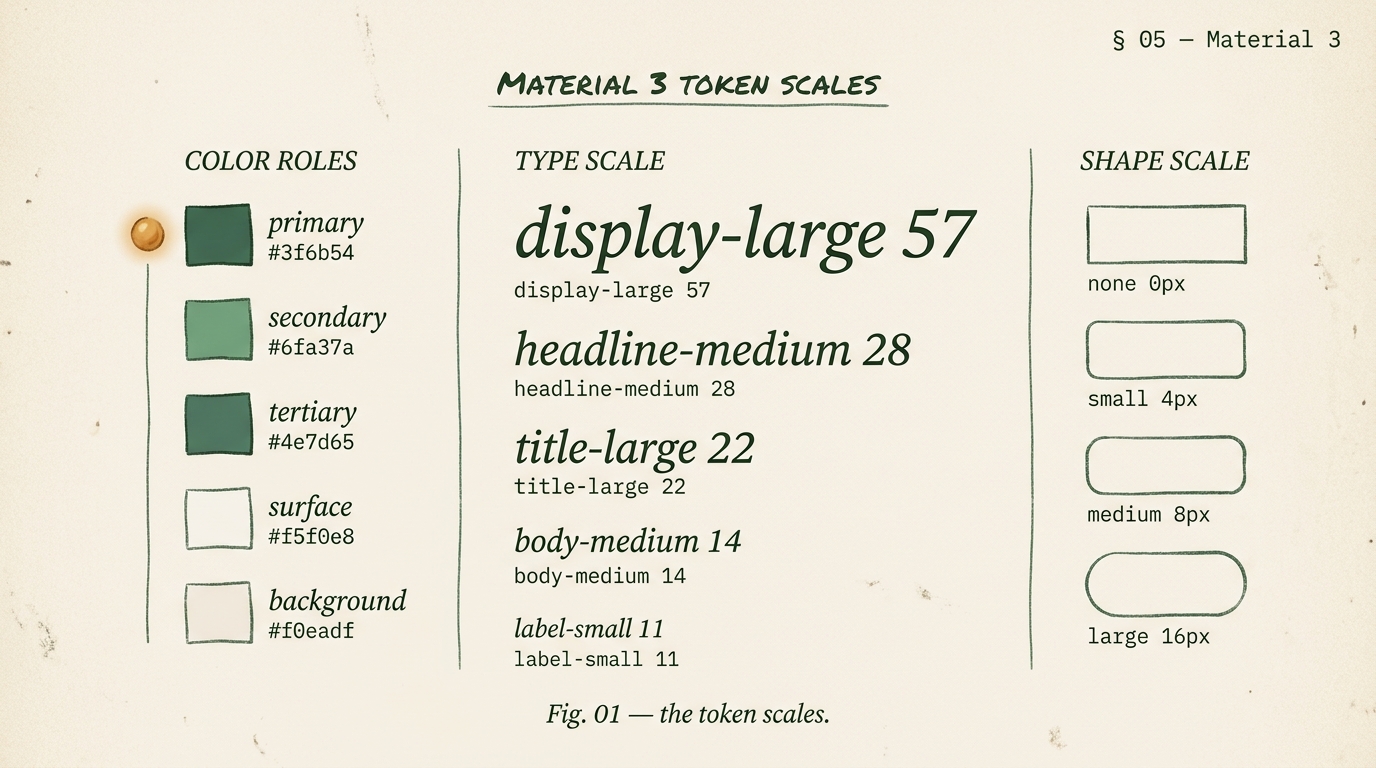
Brand color roles (primary, secondary, tertiary, surface) expressed as Material tokens. Typography scale, shape scale, elevation tokens.
API 31+: dynamic color derives from wallpaper. Your brand color becomes the fallback. Users can opt back to brand-only in settings.
Material motion (easing, duration tokens). Haptic feedback on interactive events via HapticFeedbackConstants. Makes the app feel premium.
| metric | target | note |
|---|---|---|
| cold start | < 1.8s | mid-tier Android, Baseline Profile |
| warm start | < 500ms | process resume |
| frame rate | 60 fps | sustained scroll + animations |
| APK split (per-device) | < 15 MB | ABI split + resource qualifiers |
| ANR rate | < 0.20% | Play Console vitals |
Subscription news app. Jetpack Compose, Material 3 dynamic color, Play Billing subscriptions, offline reading queue via WorkManager, dark theme. Baseline Profile shaved cold start from 2.6s to 1.5s.
Enterprise field service app for rugged tablets (Zebra, Panasonic). Min SDK 26 (older device support required). Offline-first with WorkManager sync, barcode scanner integration, signature capture. 18 weeks.
2 weeks. Min SDK decision, policy review, Compose readiness. Refundable.
10-16 weeks. Kotlin + Compose + Play Store submit.
14-22 weeks. Play Billing, WorkManager, Baseline Profiles, ABI split.
16-26 weeks. Phone + tablet + Wear OS one codebase.
min SDK 26 (Android 8.0) is our default for 2026 builds. It covers 94.1 percent of the active install base according to recent Play Store dashboards and unlocks the APIs that most modern Android apps need: notification channels, adaptive icons, background execution limits, autofill, and a clean Kotlin runtime. Going lower to 24 adds only 3 percentage points of coverage at the cost of legacy compatibility work. Going higher to 31 gains Material You dynamic color but loses 22 percent of users. For brands with a specific Material You visual identity requirement, min SDK 31 is worth the trade-off; for everyone else, 26 is the sensible floor.
US and UK senior Android engineers are $145 to $200 per hour; Indian senior Android engineers are $90 to $135 per hour. A Kotlin + Jetpack Compose MVP with 15 to 25 screens, auth, push, and Play Store submission runs 10 to 16 weeks. A full production build with Material 3 dynamic color, Play Billing, WorkManager background work, Baseline Profiles, and ABI split runs 14 to 22 weeks. A shared Kotlin Multiplatform build targeting Android phone + tablet + foldable + Wear OS runs 16 to 26 weeks. A 2-week audit is refundable. Scoped quote in 48 hours.
Jetpack Compose for new builds, always. Compose has reached full production maturity in 2026 and is the stated future of Android UI. The declarative model, Kotlin-native code, preview tooling, and tight Material 3 integration outweigh the small migration cost for teams new to Compose. XML layouts remain acceptable for ongoing maintenance of existing XML-based codebases and for specific edge cases (complex custom ViewGroups, some third-party libraries). For a new Android app in 2026, starting in Compose is the default.
Key requirements for 2026 submissions: target API level must be no more than 1 year behind latest (target SDK 34 or 35 in 2026), Data Safety form completed and accurate, privacy policy URL provided, account deletion flow required for any app with account creation, Play Integrity API for apps handling sensitive actions, per-app language settings supported, Predictive Back gesture respected. Medical, financial, and children's apps have additional specific policies we pre-check. We run a policy pre-check before every submission.
Play Billing Library version 7+ for all new builds. We implement subscriptions, non-consumable and consumable purchases, introductory pricing, promo codes, and family-shared subscription entitlements. Backend verification uses Real-Time Developer Notifications (RTDN) via Google Cloud Pub/Sub for subscription lifecycle events. For brands shipping Apple + Google Play + web, we abstract the purchase layer so the subscription logic stays platform-agnostic. Refund handling and grace period logic are implemented to Play policy requirements.
Yes. For tablets and foldables, we use WindowSizeClass to drive adaptive layouts (compact, medium, expanded) from the same Compose code. Foldable-specific features like hinge-aware layouts and outer-inner screen continuation are supported via Jetpack WindowManager. For Wear OS, we build companion apps with Compose for Wear OS, Tiles, Complications, and Watch Face Studio integrations where relevant. We scope Wear OS as an add-on to a phone build when the brand's use case benefits from wrist-first interactions.
Baseline Profiles are the biggest win. They precompile hot paths ahead of first launch, reducing cold-start time by 20 to 40 percent on mid-tier Android. We generate Baseline Profiles from Macrobenchmark tests, ship them as part of the release, and verify their impact in Play Console vitals. Beyond that: R8 full mode for minification, APK split by ABI to reduce per-device download size, App Bundle delivery through Play Asset Delivery for large assets, and WorkManager for deferrable background work that respects Doze and App Standby.
You do. Google Play Developer Console account ($25 one-time) under your legal entity. App signing key enrolled in Play App Signing (Google manages the upload key with a backup in your keystore). GitHub repository under your organization from day one. Play Console access under your control with DH engineers as named collaborators, removable any time. On exit: credentials rotated, repository transferred, CI configuration documented, 30-day support tail. No lock-in through signing, tooling, or vendor choice.
Two weeks. Min SDK decision, Play Store policy pre-check, Compose readiness, Baseline Profile plan. Refundable. Scoped quote in 48 hours.