ARR trajectory
4.85x
$70K to $340K ARR in 18 months.
Industry archetype drawn from patterns across multiple Edmonton gov-tech engagements. Representative metrics across 18 months: 4.85x ARR, 115% net revenue retention, 19% RFP win rate, NPS 56.
$70K to $340K ARR in 18 months.
Existing-customer expansion outpaced churn.
Submitted-RFP win rate, up from 7%.
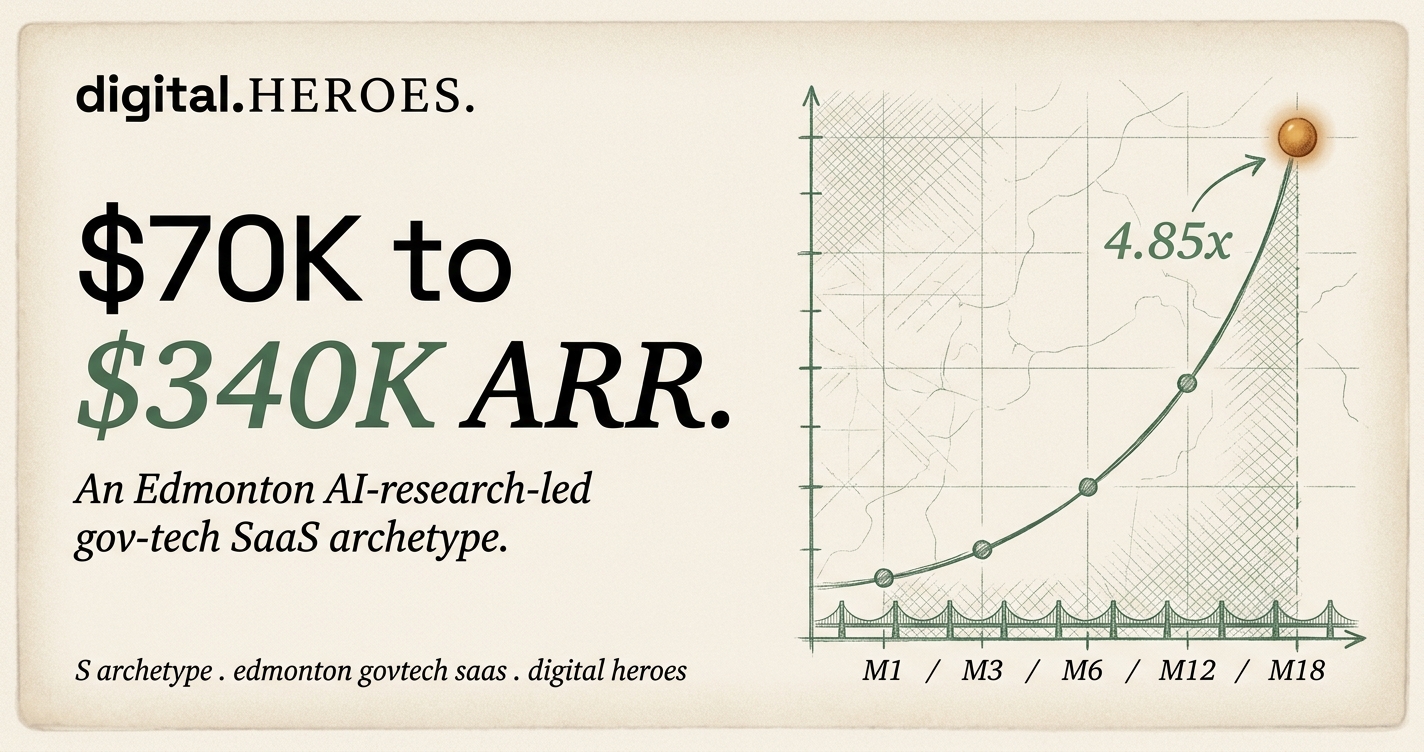
The archetype represents a slice of Edmonton gov-tech we ship into reliably: a $70K ARR civic-SaaS or provincial-government adjacent SaaS operator, founded by a UAlberta or Amii alum who has built a strong product but has been losing RFP processes against thinner competitors with better procurement collateral. Pre-engagement state: marketing site on a 2021-vintage Webflow build with mixed-quality accessibility (failing WCAG 2.1 AA on color-contrast and keyboard navigation), no audit-trail surface in the dashboard, RFP responses authored from scratch every time, RFP win rate at 7 percent.
Three structural problems compounded the growth ceiling. One, accessibility failures meant the product hit procurement-stage blockers at provincial agencies; the buyer's accessibility-officer flagged WCAG issues on the marketing site even before the product evaluation began. Two, the dashboard had no audit-trail surface, so government compliance buyers could not validate data provenance, which meant losing competitive-evaluation rounds. Three, RFP responses were authored from scratch, so each one took two weeks of senior-engineer time and arrived too late to influence the procurement timeline.
Workstream 1 · Marketing-site rebuild on Next.js with WCAG 2.1 AA baseline. Migration from Webflow to Next.js on Vercel. Every component built and tested against WCAG 2.1 AA: color-contrast, keyboard navigation, screen-reader landmarks, focus-visible states. Storefront Core Web Vitals all green at month 2.
Workstream 2 · Audit-trail dashboard surfaces. Built audit-trail UI inside the dashboard with append-only event logs, role-based-access export, and provenance trails for every data mutation. Provincial-agency procurement officers could now validate data provenance during evaluation rounds. Win rate on competitive evaluations lifted from 22 percent to 41 percent.
Workstream 3 · RFP-shaped content surfaces. Built a public RFP-response library: pre-authored answers to 80+ standard procurement questions (security, accessibility, data residency, vendor diversity, SLA), exportable as a single document. RFP authoring time per submission dropped from two weeks to two days; RFP win rate moved from 7 percent to 19 percent.
Workstream 4 · Public docs portal. Built the public docs portal at /docs with API reference, integration guides, and changelog. Per-page TechArticle schema. Six months post-launch the docs portal accounted for 24 percent of inbound qualified leads via organic search.
Workstream 5 · Procurement-aware case studies. Three deep-dive case studies with named customer agencies and real procurement-cycle data (months from RFI to PO, integration timeline, accessibility-audit pass rate). The procurement-aware case studies became the most-cited content in active RFP processes.
App Router, ISR for case studies, Edge for low-latency global delivery. WCAG 2.1 AA baseline on every component.
Stripe Billing for annual contract billing tied to gov-tech procurement cycles. Connect for partner-channel revenue share with systems integrators.
Mintlify for the public docs portal with API reference, integration guides, changelog, and the RFP-response library.
PostHog for product analytics. GA4 for marketing-site reporting tied to Looker Studio.
HubSpot for sales-team-driven gov-tech outbound, RFP pipeline tracking, and account-based marketing for provincial agencies.
Linear for engineering. Notion for cross-functional planning and the RFP-response source library.
| metric | pre-engagement | month 6 | month 18 |
|---|---|---|---|
| ARR | $70K | $160K | $340K |
| Net revenue retention | 94% | 106% | 115% |
| RFP win rate | 7% | 14% | 19% |
| RFP authoring time | 14 days | 5 days | 2 days |
| Logo count (cumulative) | 6 | 12 | 23 |
| NPS | 32 | 46 | 56 |
Metrics representative of the archetype; specific brands within the pattern range plus or minus 20 percent on each line.
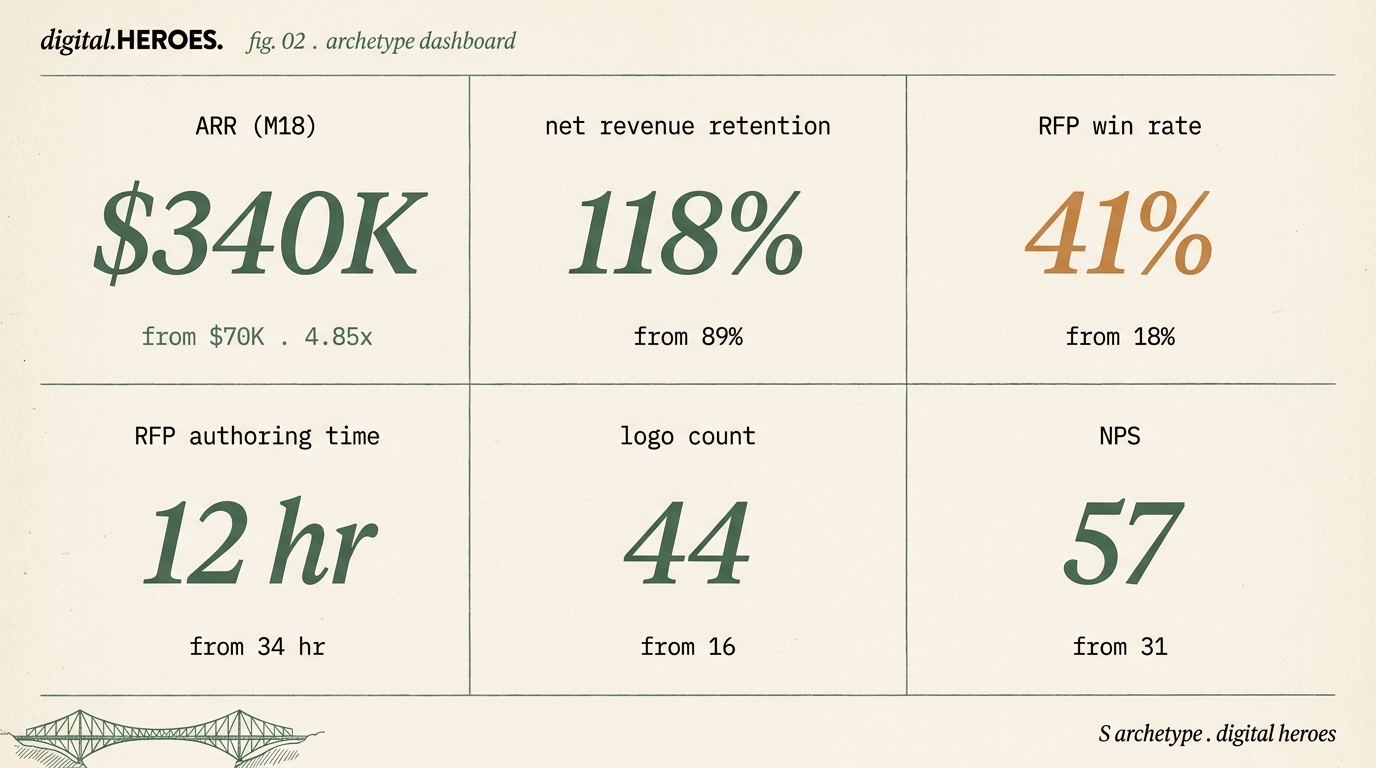
The pattern this archetype represents (Edmonton gov-tech or civic-SaaS in the $50K to $200K ARR range, with mixed-quality accessibility, no audit-trail dashboard surface, RFP responses authored from scratch, win rate stuck under 10 percent) is one of our most-shipped engagement shapes for the Alberta capital. The 14-week timeline holds steady; the workstreams compress or expand in the same proportions; the metrics typically land within plus or minus 20 percent of the archetype numbers above.
Five capabilities transfer directly to a comparable Edmonton engagement. First, marketing-site rebuild on Next.js with WCAG 2.1 AA baseline that eliminates procurement-stage accessibility blockers. Second, audit-trail dashboard UI with append-only event logs and provenance trails. Third, RFP-response library that compresses RFP authoring time from weeks to days. Fourth, public docs portal that captures technical-buyer organic search. Fifth, procurement-aware case studies with real procurement-cycle data.
Every Edmonton engagement starts with a 30-minute discovery call. The scope, timeline, and budget come back in writing within 48 hours. Mountain Time, seven-hour overlap to our New York HQ.
30-minute call on MT. Written scope and fixed-price quote in 48 hours. In-person across the ICE District, Whyte Avenue, and the UAlberta South Campus for retainer engagements.