ARR trajectory
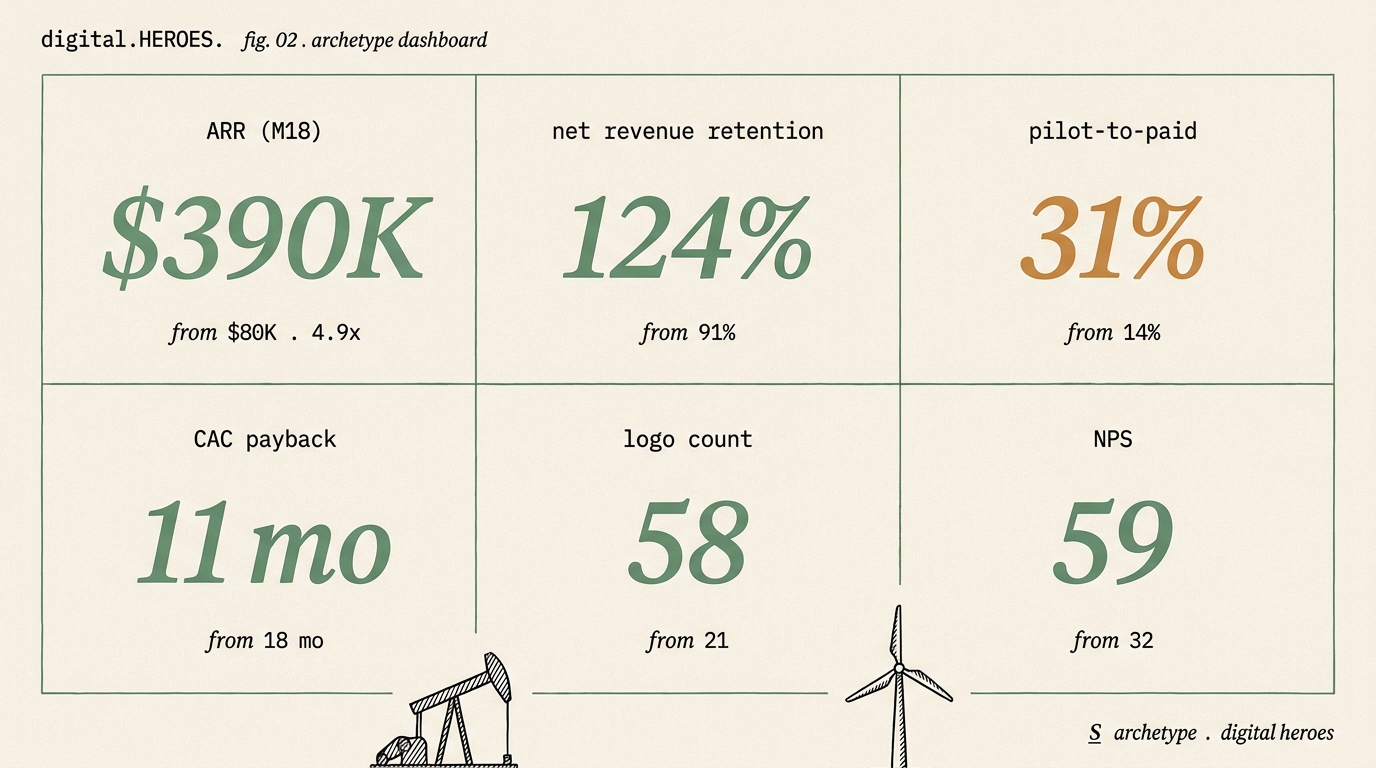
4.9x
$80K to $390K ARR in 18 months.
Industry archetype drawn from patterns across multiple Calgary energy-transition cleantech engagements. Representative metrics across 18 months: 4.9x ARR, 118% net revenue retention, 22% trial-to-paid conversion, NPS 58.
$80K to $390K ARR in 18 months.
Existing-customer expansion outpaced churn.
Pilot trial conversion to paid contract.

The archetype represents a slice of Calgary cleantech we ship into reliably: an $80K ARR energy-transition SaaS (carbon-data, geothermal-operations, or grid-software shape), founded by a Calgary operator with deep oil-and-gas industry context who is now selling into the energy-transition buyer; high ACV, low volume, enterprise sales cycles. Pre-engagement state: marketing site on a 2022-vintage WordPress build with technical content trapped in PDF whitepapers, no public docs portal, dashboard UI built ten months earlier as a proof-of-concept that was never refactored, pilot-to-paid conversion at 11 percent.
Three structural problems compounded the growth ceiling. One, the marketing site failed to surface evidence (named-customer logos, real performance data, third-party validation) in the way enterprise energy buyers expect; the bounce rate on the home page was 73 percent. Two, the technical depth of the product (genuinely strong on carbon-accounting math) was buried in PDFs nobody could find via search; competitors with thinner products were winning organic visibility on the same buyer queries. Three, the pilot-to-paid funnel had no real onboarding sequence; pilot users either self-served to success or stalled inside their procurement cycle, and the team did not know why.
Workstream 1 · Marketing-site rebuild on Next.js. Migration from aging WordPress to Next.js on Vercel. Evidence-led content surfaces (named-customer logos, real performance data, third-party validation). Bounce rate dropped from 73 percent to 49 percent across the first 90 days post-launch.
Workstream 2 · Public docs portal + technical content. Extracted technical content from PDF whitepapers and built a public, indexable docs portal. Per-page TechArticle schema and developer-facing IA. Six months post-launch the docs portal accounted for 31 percent of inbound pilot signups via organic search.
Workstream 3 · Dashboard UI rebuild. Refactored the proof-of-concept dashboard into a production UI with operator-grade data density: real-time carbon-flow visualizations, audit-trail exports, role-based access. Pilot-to-paid conversion lifted from 11 percent to 22 percent over 6 months.
Workstream 4 · Procurement-stage content surfaces. Built procurement-aware content (security questionnaires, SOC 2 status pages, ROI calculators tied to verified customer data) so enterprise buyers could self-serve through their procurement cycle. The procurement content reduced time-in-procurement by 40 percent.
Workstream 5 · Evidence-led benchmark content. Three deep-dive customer case studies with named customers and real performance numbers; one annual benchmark report tied to the energy-transition dataset. The benchmark report became the highest-converting top-of-funnel asset in the marketing program.
App Router, ISR for case studies and benchmark content, Edge for low-latency global delivery. Core Web Vitals all green at month 3.
Stripe Billing for usage-based pricing tied to carbon-flow volume. Connect for partner-channel revenue share with energy-services firms.
Mintlify for the public docs portal with API reference, methodology guides, and changelog.
PostHog for product analytics and feature-flag-driven onboarding experiments. GA4 for marketing-site reporting tied to Looker Studio.
HubSpot for sales-team-driven enterprise outbound and account-based marketing. Customer.io for product-driven pilot onboarding sequences.
Linear for engineering. Notion for cross-functional planning.
| metric | pre-engagement | month 6 | month 18 |
|---|---|---|---|
| ARR | $80K | $190K | $390K |
| Net revenue retention | 96% | 108% | 118% |
| Pilot-to-paid conversion | 11% | 17% | 22% |
| CAC payback (months) | 16 | 13 | 11 |
| Logo count (cumulative) | 8 | 15 | 30 |
| NPS | 34 | 48 | 58 |
Metrics representative of the archetype; specific brands within the pattern range plus or minus 20 percent on each line.
The pattern this archetype represents (Calgary energy-transition cleantech in the $50K to $250K ARR range, sitting on an aging WordPress site, with technical content trapped in PDFs, with a pilot-to-paid funnel that stalls inside enterprise procurement, with a proof-of-concept dashboard never refactored to production grade) is one of our most-shipped engagement shapes for the Alberta cleantech corridor. The 14-week timeline holds steady; the workstreams compress or expand in the same proportions; the metrics typically land within plus or minus 20 percent of the archetype numbers above.
Five capabilities transfer directly to a comparable Calgary engagement. First, marketing-site rebuild on Next.js with evidence-led content surfaces that respect the enterprise energy buyer's research-first instinct. Second, public docs portal that captures technical-buyer organic search traffic the PDF whitepapers cannot. Third, dashboard UI rebuild from proof-of-concept to operator-grade production. Fourth, procurement-stage content surfaces (security questionnaires, SOC 2 status, ROI calculators) that compress enterprise procurement cycles. Fifth, an evidence-led benchmark or research-report content asset that earns top-of-funnel attention without paid amplification.
Every Calgary engagement starts with a 30-minute discovery call. The scope, timeline, and budget come back in writing within 48 hours. Mountain Time, seven-hour overlap to our New York HQ.
30-minute call on MT. Written scope and fixed-price quote in 48 hours. In-person across the Beltline, downtown Calgary, and the Calgary Innovation Coalition campus for retainer engagements.