A pragmatic Magento 2 and Adobe Commerce practice for brands past $5M GMV running enterprise catalogs, multi-store, B2B, and complex tax. We know the platform's strengths, and we will name the day it is time to move.
Magento still runs enterprise catalogs. But the calendar is running too.
Magento 2 (Adobe Commerce and Open Source) still powers more of the internet's enterprise catalogs than any other self-hosted platform. The question is never whether Magento can do the job; it is whether the support calendar, the upgrade cost, and the hiring market for Magento engineers add up against alternatives over a 3-year window. We run Magento for brands where the platform's strengths are genuinely required, and we run the migration to Shopify Plus for brands where the math has flipped. The audit tells which side you are on.
stay on magento when
✓Catalog is 10K+ SKUs with complex attributes, tiered pricing, multi-warehouse inventory
✓B2B with company accounts, catalog visibility per group, NET terms, approval workflows
✓Multi-store multi-brand across currencies, languages, catalogs on one instance
✓International tax rules that SaaS platforms cannot express (per-country, per-region)
✓Enterprise ERP integration (NetSuite, SAP, Dynamics) already in place
migrate when
×Annual hosting + retainer + license together exceed Shopify Plus + build amortized over 3 years
×Your Magento engineer just left and the hiring replacement timeline is 4+ months
×Your catalog complexity turned out to be a Shopify metafield and a collection rule away
×Your B2B needs fit Shopify Plus B2B (company accounts shipped default in Plus)
×Checkout conversion is the biggest lever and Shopify's checkout is the moat
§ 02 · open source vs adobe commerce
Same engine. Very different bill.
Magento Open Source and Adobe Commerce share the core engine. Everything built on Open Source runs on Commerce. The difference is what Commerce adds on top: page builder, targeted rules, advanced search on Elasticsearch, B2B module, and official Adobe support. The license bill for Commerce is $22K-$125K per year depending on GMV. Most of our mid-market engagements run Open Source because the Commerce features can be replicated or sourced from community extensions. Enterprise brands (typically $50M+ GMV) often choose Commerce for the official support and page builder.
dimension
Open Source
Adobe Commerce
license fee
$0
$22K-$125K annual
page builder
via extension (free or $300 one-time)
included, tightly integrated
B2B module
via extension ($600-$2K)
included, official
targeted rules
build yourself or extension
included
elastic search
self-hosted Elasticsearch or OpenSearch
Adobe Live Search included
support
community + your agency
Adobe SLA
cloud option
self-host anywhere
Adobe Commerce Cloud (managed)
§ 03 · the catalog reindexer, in motion
Nine indexers. One warm cache.
Magento 2's nine indexers are the heart of catalog performance. Misconfigured, they reindex on save and slow admin to a crawl. Tuned to "Update on Schedule" with cron-driven batch processing, they keep the storefront cache warm while admin edits fly. The animation below is an illustrative catalog reindex on a 100K SKU store.
Fig. 1 · the catalog reindexer · nine indexers, one warm cache
§ 04 · the nine indexers, named
The one that always owns your Monday is Product Price.
Every Magento admin has watched the Product Price indexer run for 45 minutes on a Monday morning after a catalog rule change. Understanding what each indexer does, when to set it to "Update on Schedule" versus "Update on Save", and how to batch-process during low-traffic windows is half of Magento performance work.
01 · design config
Fast. Rebuilds on theme or config change. Safe at "Update on Save".
02 · customer grid
Admin customer search index. Rebuild batches on customer imports.
03 · category products
Which products belong to which categories. "Update on Schedule" for large catalogs.
04 · product categories
Reverse lookup. Required for storefront tree rendering. Schedule-mode.
05 · product price
The slowest. Tier pricing, catalog rules, customer group prices, tax-inclusive. Always schedule-mode, nightly rebuild ideal.
06 · product attribute
Filterable attribute index for layered navigation. Schedule-mode.
07 · catalog rule product
Catalog price rules per product. Rebuild on rule changes.
08 · catalog product rule
Which rules apply to a product. Schedule-mode.
09 · stock
Inventory index. Multi-source inventory stores have the heaviest reindex cost.
§ 05 · hyva vs pwa studio vs luma
Three frontends. Three different bills.
The biggest Magento 2 performance decision is the frontend. Hyva Themes on Alpine JS and Tailwind typically drops LCP from 4-6 seconds to 1.5-2.2 seconds without a PWA rewrite. PWA Studio gives you a React-based storefront at higher engineering cost. Luma is the default theme that ships with Magento and hits a performance ceiling.
Luma (default)
Hyva Themes
PWA Studio
stack
jQuery + Knockout + LESS
Alpine JS + Tailwind CSS
React + GraphQL
LCP mobile typical
4-6s
1.5-2.2s
1.2-2.0s
rebuild cost
low (stays as-is)
10-16 weeks
14-24 weeks
extension ecosystem
every Magento extension works
~80% extensions compatible; others need Hyva port
narrowest, React-rewrites needed
best for
stores keeping Magento as legacy
80% of modern Magento rebuilds
brands with React app-shared codebase
§ 06 · multi-store + multi-brand
One instance. Many storefronts.
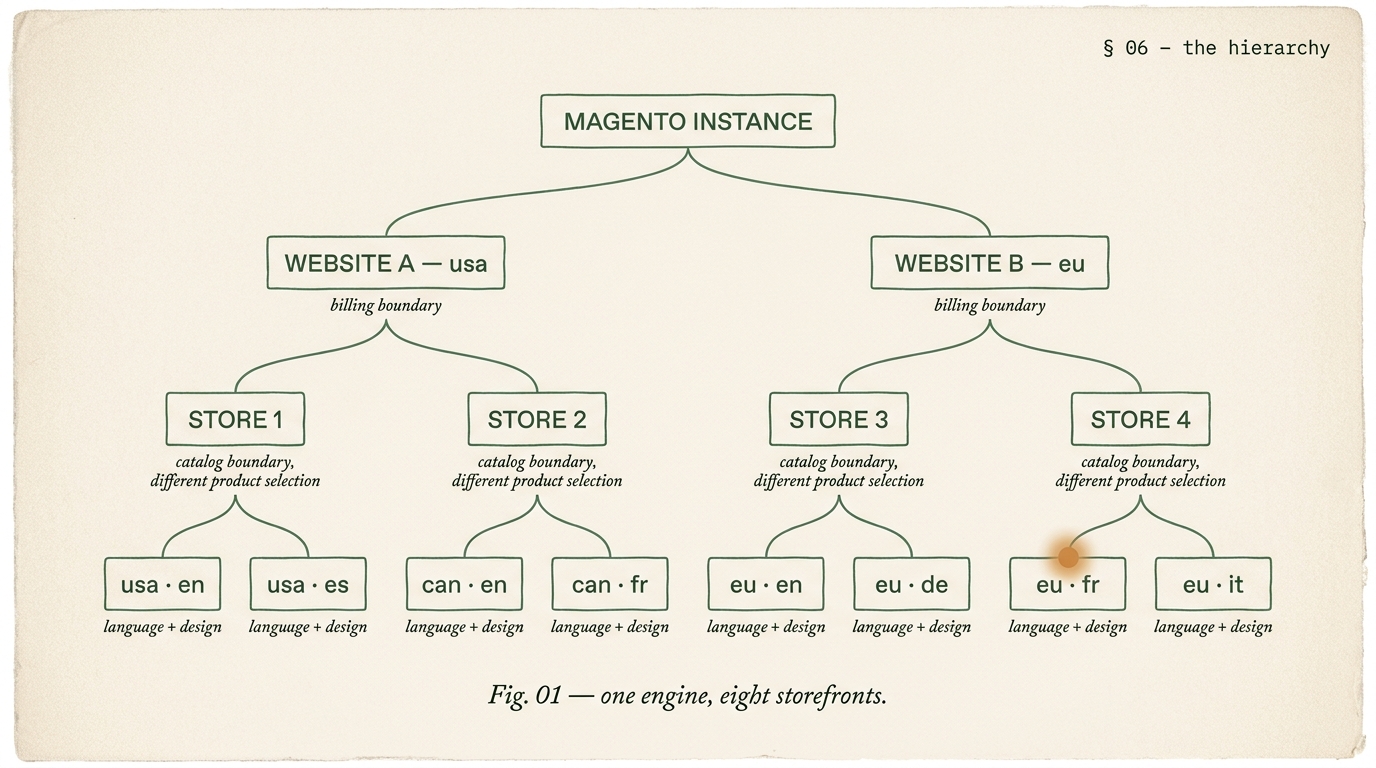
Magento's three-level hierarchy (Website, Store, Store View) handles multi-brand and multi-region cleanly on a single install. Shared or isolated catalog, shared or isolated customer base, per-store pricing, per-store payment, per-store tax. The architecture decision happens in the first week of every multi-brand engagement and it sets the ceiling for everything downstream.
Fig. 2 · one engine, eight storefronts · the three-level hierarchy
level 01 · website
Billing boundary.
Defines customer scope (shared customer base across websites or isolated), payment methods, base currency. Usually one website per legal entity.
level 02 · store
Catalog boundary.
Root category determines which products a store sells. Multiple stores per website share customer base but can offer different catalogs. Useful for B2B vs DTC on one instance.
level 03 · store view
Language and design.
Locale, translations, per-view theme. Multi-language sites use store views per language; multi-country sites often use separate stores for catalog differences.
§ 07 · b2b on magento
B2B on Magento is the native answer.
Magento's B2B module (bundled with Adobe Commerce, available via extension on Open Source) covers the full enterprise B2B surface: company accounts with sub-users, internal approval workflows, quote-to-order, NET payment terms, per-customer catalog visibility, tiered and contract pricing, and tax exemption flows. This is one of the platform's strongest value propositions; Shopify Plus B2B is catching up but Magento still wins on the deeper edge cases.
company accounts
✓Parent company with multiple sub-accounts, org hierarchy up to 10 levels
✓Per-user role: admin, buyer, approver, viewer
✓Approval workflows by order value, item count, or custom rule
✓Shared cart visibility across company
quote + NET terms
✓Request for Quote flow with negotiated pricing
✓NET-15, NET-30, NET-60 payment method with credit limit
✓Per-customer custom catalogs (visible SKUs)
✓Tax-exempt flows with certificate upload
§ 08 · tax + payment localization
International tax is where Magento earns its license.
Multi-region tax is one of the genuinely hard problems SaaS platforms struggle to express. Magento integrates directly with TaxJar, Avalara, and Vertex through official connectors, plus supports native tax rules per store view, per customer group, and per product class. The combination handles EU VAT (including OSS and IOSS), UK VAT post-Brexit, US sales tax across all 50 states, Canadian GST/HST/PST, and Australian GST with the same architecture.
taxjar
US + Canada focus.
Best pick for US-first brands with Canada. Economic nexus monitoring, rate API, reporting. $19-$300/mo depending on volume.
avalara
Global enterprise.
Most comprehensive. 12,000+ tax jurisdictions. Required for brands shipping to 20+ countries. Higher cost, includes filing services.
vertex
Complex B2B tax.
Wholesale, tax-exempt certificates, use tax, manufacturing exemptions. Right pick for industrial distributors and complex B2B.
§ 09 · performance SLA
The numbers we hold ourselves to on Hyva.
Most Magento performance complaints are about Luma-era baselines. On a properly-tuned Hyva build with Elasticsearch, Redis full-page-cache, and Varnish, the numbers below are what we hold ourselves to on mid-tier Android over throttled 4G.
template
LCP
INP
CLS
note
homepage
< 2.0s
< 150ms
< 0.05
hero + featured products
category / layered nav
< 2.4s
< 180ms
< 0.08
100+ SKUs filterable
product (configurable)
< 2.2s
< 180ms
< 0.08
variation swatches
cart
< 2.2s
< 200ms
< 0.10
tax calc round trips
checkout
< 2.5s
< 200ms
< 0.10
payment iframe + tax service
§ 10 · security + pci scope
Magento starts at SAQ-A-EP. We engineer down to SAQ-A.
Unlike SaaS platforms that auto-qualify for SAQ-A, self-hosted Magento defaults to SAQ-A-EP (the merchant controls the checkout page even if tokenized). We architect checkouts to stay at SAQ-A by using hosted payment fields, redirect flows, or Adyen-style drop-in components where the payment iframe loads from the gateway origin and card data never reaches your server or your checkout's DOM.
scope reduction
✓Stripe Elements or Braintree Hosted Fields for checkout; no card data on Magento server
✓TLS 1.2+, HSTS minimum 1 year with subdomain inclusion
hardening
✓Admin URL rotated off /admin; 2FA enforced on all admin users
✓Magento security patches applied within 30 days of release
✓Extension vulnerability monitoring via Sansec or equivalent
✓File integrity monitoring with baseline diff alerting
§ 11 · the migration question
If the math has flipped, we will tell you.
Our readiness audit calculates total cost of ownership: hosting, license (if Adobe Commerce), retainer cost of Magento-capable engineering, extension licenses, and upgrade overhead. We compare that honestly against Shopify Plus plus a rebuild amortized over 3 years. If migration wins, we run it ourselves through our Shopify migration practice. If staying wins, we run the Hyva rebuild. We have no ideological commitment to either platform.
§ 12 · proof
Two archetypes. One stayed, one moved.
archetype 01 · B2B industrial, $18M GMV
Stayed: Luma → Hyva + B2B rebuild.
35K SKU catalog, 140 B2B customers with per-company catalogs and NET-30 terms. Luma LCP at 5.2s killing search rankings. Hyva rebuild + B2B module upgrade + TaxJar integration. 14-week engagement.
LCP mobile
1.8s
from 5.2s
indexer time
-72%
schedule-mode
B2B reorder
+46%
90d post
archetype 02 · DTC home goods, $8M GMV
Moved: Magento → Shopify Plus.
12K SKU home goods brand on Adobe Commerce Cloud. License + hosting + retainer at $165K/year. Catalog complexity was manageable in Shopify metafields. Migration to Plus saved $90K/year. 16-week migration.
annual saving
$90K
3-year ROI
URL kept
99.4%
90d check
checkout conv
+18%
Shop Pay
§ 13 · engagement shapes
Four shapes. The audit names the right one.
shape 01
Readiness audit.
3 weeks. Indexer health, cache, extensions, TCO vs Shopify. Refundable. Contact for quote.
shape 02
Hyva frontend.
10-16 weeks. CWV rebuild on Alpine + Tailwind. Contact for quote.
shape 03
Custom build.
14-24 weeks. Multi-store, B2B, tax, ERP. Contact for quote.
shape 04
Migration out.
12-20 weeks. Magento → Shopify Plus with 99% URL kept. Contact for quote.
§ 14 · questions
Eight answers.
Is Magento 2 still a good choice in 2026?
For the right brand, yes. Magento 2 Open Source wins when you run a complex catalog (10K+ SKUs with tiered pricing, multi-warehouse inventory, or complex attribute sets), when B2B requirements rule out Shopify (company accounts with internal approval, NET terms, catalog visibility per customer group), or when international tax rules need per-country logic that SaaS platforms do not expose. Adobe Commerce wins when the brand needs Enterprise features (targeted rules, page builder, advanced search) and can absorb the license cost. For $1M to $5M brands with simpler catalogs, Shopify or Shopify Plus is usually the honest answer and we say so.
Should we move from Magento to Shopify Plus?
Sometimes. The math flips when your Magento maintenance cost, hosting cost, and developer retainer together exceed Shopify Plus's annual fee plus a build-cost amortized over 3 years. That usually happens for brands between $5M and $30M GMV whose B2B needs fit Shopify's B2B features and whose catalog complexity is not genuinely Magento-specific. Brands above $50M with real multi-warehouse, multi-region tax, and complex B2B requirements often stay. We run Magento and Shopify Plus both; the decision is unsentimental, numbers-based, and we will tell you which way it goes on our side of the audit.
How much does custom Magento development cost in 2026?
Magento work costs more than Shopify or WooCommerce at every project shape. US and UK senior Magento engineers are $140 to $200 per hour at boutique agencies; Indian mid-market senior engineers are $90 to $140 per hour. A Hyva or PWA Studio frontend rebuild runs 10 to 16 weeks. A custom Magento build with B2B, multi-store, and tax integration runs 14 to 24 weeks. Enterprise Adobe Commerce engagements with ERP integration run 20 to 40 weeks. A readiness audit is 3 weeks and is refundable. Scoped quote in 48 hours.
Hyva vs PWA Studio vs Luma - which frontend?
Hyva Themes (Alpine JS + Tailwind CSS) is our default for brands that want dramatic CWV improvement without a PWA rewrite. Typical LCP drops from 4-6 seconds on Luma to 1.5-2.2 seconds on Hyva. PWA Studio is the right pick for brands committed to a React-based storefront, willing to pay the engineering cost for offline support, app-like interactivity, and a shared codebase with mobile. Luma (the default theme) is acceptable for small catalogs and basic stores but hits a performance ceiling. We benchmark all three before recommending.
How do you handle Magento multi-store and multi-brand?
Magento's multi-store architecture is one of the platform's genuine strengths. One Magento instance runs multiple storefronts across different domains, currencies, languages, and catalogs with shared or isolated customer bases. We design the store hierarchy at the start of every multi-brand engagement: website (billing boundary, customer scope), store (catalog scope), and store view (language and design). Shared SKU catalogs with per-store pricing, per-store tax rules, and per-store payment methods. The decision early on is whether catalog is shared across brands or isolated; we have shipped both shapes.
How do you integrate Magento with ERP systems?
Named integrations with NetSuite, SAP, Microsoft Dynamics, QuickBooks Enterprise, and Acumatica. Three patterns cover most: bi-directional via middleware (Boomi, MuleSoft, Celigo) for mid-market brands; direct API integration for simpler ERP like QuickBooks or Xero; and custom message-queue architecture for enterprise Adobe Commerce deployments with real-time inventory. We always isolate the integration in a dedicated Magento module or external middleware, never inline in the theme, so that upgrades do not break the data flow. Failure modes are monitored and alertable from day one.
What does PCI compliance look like on Magento?
Magento out-of-the-box can end up at SAQ-A-EP (the stricter self-assessment) because the checkout page itself is hosted on your server even if card data is tokenized. To stay at SAQ-A, we configure payment integrations (Stripe, Braintree, Adyen) to use hosted payment fields or redirect checkouts where the card data never touches your Magento server. We audit the checkout for script origins and Content Security Policy, ensure no card data is logged, and verify TLS 1.2+ with HSTS. For enterprise Adobe Commerce, we can architect to stay at SAQ-A-EP with full documentation support during QSA audits.
Who owns the Magento installation, custom modules, and data?
You do. Magento installation on your hosting (MageMojo, Nexcess, AWS, or your own infrastructure), all custom modules in a private GitHub repository under your organization from day one, admin access under your user, ERP credentials in your control. We are added as named engineers and you remove us any time. On exit we transfer the repository, document every custom module, record a Loom walkthrough of any non-obvious architectural choice, and leave a 30-day support tail. No lock-in through code or config.
Start with the readiness audit.
Three weeks. Indexer health, cache, extensions, and honest TCO vs Shopify Plus. Refundable against any engagement that follows. Scoped quote in 48 hours.