signal 01 · shipping % of revenue
under 18%.
Shipping costs as a share of revenue. Above 25% on a perishable catalog means multi-warehouse routing is not in place. Threshold basket logic and kit minimums bring this down fast.
A specialty food, coffee, beverage, and CPG ecommerce practice that treats perishability, cold chain, and FDA FSMA as platform features, not afterthoughts. Shopify Plus builds, subscription kit design, flavor and variant logic, ship-by-date routing, multi-warehouse inventory.
Food and beverage brands die not from marketing but from margin leaks in the cold chain. Before any paid push, any Shopify rebuild, any new kit launch, run the brand against these five signals. Every number is measured inside your Shopify analytics, your Klaviyo cohorts, and your subscription platform.
Shipping costs as a share of revenue. Above 25% on a perishable catalog means multi-warehouse routing is not in place. Threshold basket logic and kit minimums bring this down fast.
Percentage of orders that are subscription. F&B compounds fastest through subscription. Below 25% means the subscribe option is hidden or the cadence is wrong.
Monthly churn on the subscription base. Above 8% means cadence is out of phase with consumption or skip controls are hidden behind a cancel request.
Actual median days between first and second purchase versus product consumption duration. A 2lb coffee bag lasts ~30 days; a replenishment at day 35 is in phase. Day 60 is broken.
Spoilage and damage as percentage of shipped units. Above 3% signals carrier SLA or packaging failure. The cheapest place to rebuild margin.
Brands passing four of five are ready for a growth partnership. Two or fewer and the Cold Chain Method rebuild is the place to start.
Most food brands treat shipping as a post-checkout afterthought. The result is guessed-at costs, Thursday-shipped perishables dwelling the weekend in a warehouse, and spoilage claims eating margin. Four temperature bands on every SKU, stored as metafields, read by cart and checkout. Everything downstream follows.
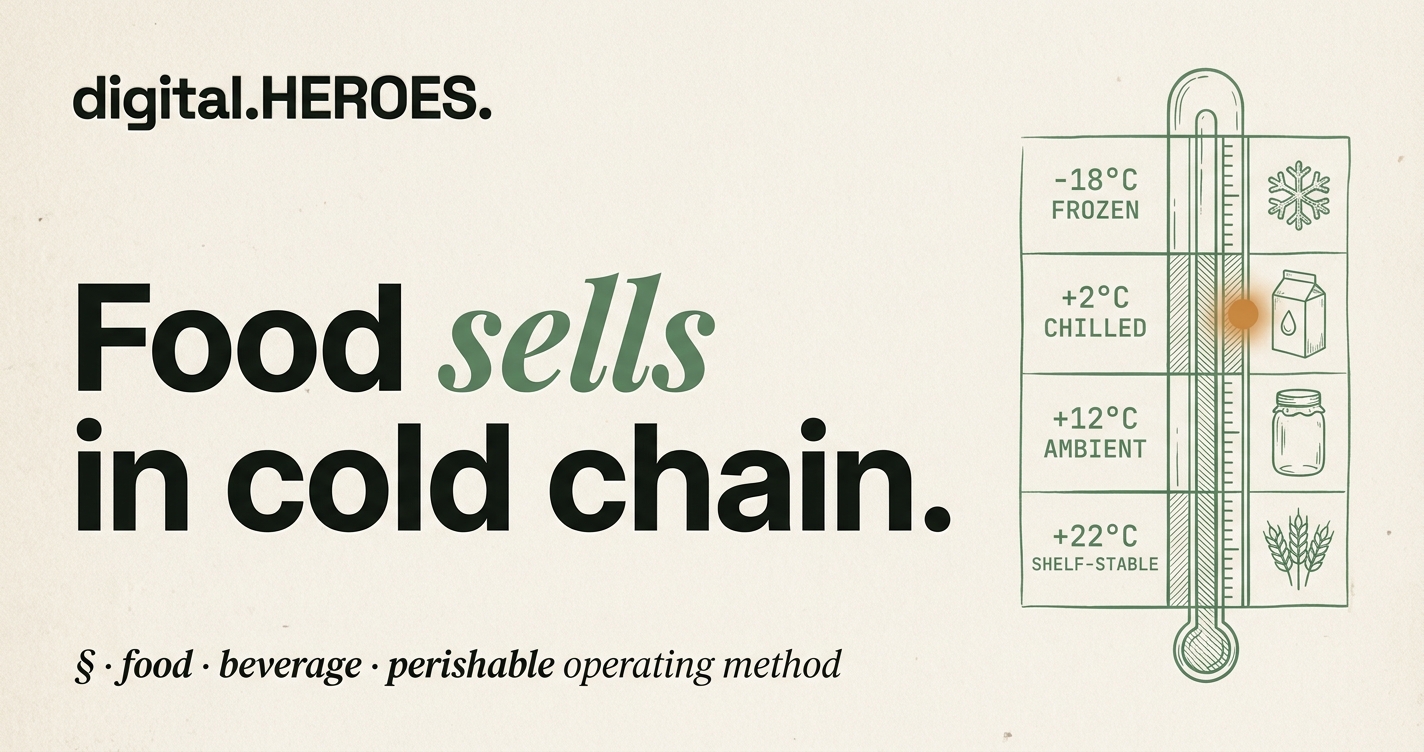
2-day air with gel packs or dry ice. Ships Monday to Wednesday only. Carrier: FedEx or UPS.
Next-day ground with insulated liner plus gel. Ships Mon-Wed. Requires cold-warehouse adjacency.
Ground 2-5 day. No cold pack required but seasonal summer routing caution for chocolate, waxes.
Any carrier, any day. The only band that can ship economy. 60-70% of F&B SKUs ideally sit here.
The 15% subscribe-and-save widget ships in one afternoon. A kit builder that rotates flavors, lets a buyer skip next week, swaps in seasonal SKUs, and matches cadence to product consumption takes a month. The first is a discount on a transaction; the second is a product.
Buyer picks 4 of N available flavors. Kit locks once a month. Next cycle the buyer rotates in two new flavors. Default to "repeat last kit" with a one-tap change.
2lb coffee ~30 days. 12oz bar ~7 days. 12 pack beverage ~21 days. Each SKU carries its own consumption window as a metafield; cadence reads from there.
Skip controls live in one tap from the account page and from every transactional email. Skip before the box ships, not after, so a skip costs the brand zero.
Subscribe-and-save stays as baseline. Membership adds early access to seasonal SKUs, educational content, tasting events, and surprise drops. Members churn at half the rate.
Stack sprawl kills F&B margin faster than ad inefficiency. One pick per category. This is our 2026-Q2 default.
Subscription complexity, multi-warehouse, wholesale portal. The only platform where kit builders, cold-chain routing, and distributor ordering coexist.
ReCharge for scale. Stay AI for brands wanting AI-tuned cadence and churn prediction. Smartrr for members-club models.
Multi-warehouse routing by zone and temperature class. Day-of-week ship rules for perishable SKUs. Integration with carrier APIs for real-time rate shop.
Attribute-level filtering (flavor profile, dietary fit, brew method). Syndicates to Google Shopping. PDP density target 100+ per hero SKU.
Macros for F&B tickets: spoilage, melted chocolate, missed delivery, skip request, flavor swap. AI-assist cuts response 40% with the right macro library.
FSMA preventive controls. FSVP for imports. Allergen declarations. Nutrition panels. Country of origin labeling. Prop 65 for California. Each is a data field on the product, not a PDF in a shared drive. Four artifacts every F&B brand renders from the Shopify catalog.
Structured metafields hold nutrition facts, allergen list, and ingredient order. One edit propagates to PDP, Amazon Fresh catalog, Whole Foods upload, and wholesale buyer portal. No spreadsheets.
"Organic", "gluten-free", "keto", "non-GMO" each carry a reference ID to a certification file. When a retailer or the FTC asks, the answer is a URL, not a search.
Every shipment logs the lot numbers included. A recall becomes a database query instead of a call center operation. FSMA 204 traceability rule compliant by design.
California orders show Prop 65 warning where applicable. Country of Origin Labeling renders from catalog. Driven by geolocation at cart and per-SKU flags, not by separate stores.
A DTC F&B brand above $5M ARR is almost always multi-channel. Running five catalogs manually is how pack configurations drift. Shopify stays the source of truth; everything else is downstream.
Source of truth. Full catalog, subscription, membership.
Hero SKUs, pack sizes adjusted for Prime logistics.
Shelf placement, seasonal features, brand discovery.
Marketplace with aligned buyer mindset; good trial channel.
UNFI, KeHE, regional specialty. B2B portal on Shopify Plus.
Inventory allocation across five channels is the hardest operational problem in a scaling F&B brand. Our build includes the allocation logic.
A well-run F&B brand runs shipping under 18% of revenue. A poorly run one runs 30%+. The difference is three levers most brands never touch because shipping is treated as a fulfilment problem, not a growth problem.
Free shipping minimums vary by zone. $65 in zones 1-4, $95 in zones 5-8. Cart messaging surfaces the delta. AOV rises 12-18% without margin loss.
Order routes to the warehouse nearest the destination with the SKU in stock. Drops zone costs by 1-3 zones on average. Cuts ship time too.
No perishable box leaves Thursday for weekend dwell. Checkout routes Fri-Sun orders to Monday ship with an honest ETA. Spoilage claims drop 40%+.
F&B margins are thin. A wrong engagement pushes a brand below break-even fast. Here is our honest filter.
Five layers, run in order. Shelf-life first because nothing above matters if product arrives spoiled. Cold-chain routing next. Subscription kit third. Compliance fourth. Channel syndication last, once the four below are stable.
Per-SKU best-by and ship-by dates as metafields. Cart and checkout enforce minimum remaining consumable window. No box leaves with product at the edge of its honest life.
Warehouse assignment by destination zone, SKU temperature class, carrier SLA. Day-of-week rules for perishable. Real-time rate shop; cheapest acceptable wins.
Kit builder UX. Flavor rotation. Consumption-matched cadence per SKU. Skip before ship, not after. Membership tier above the subscribe-and-save baseline.
FSMA preventive controls, FSVP for imports, allergen rendering, nutrition panels, lot traceability, Prop 65 and COOL surface logic. One catalog edit, everything downstream.
DTC as source. Amazon Fresh, Whole Foods, Thrive, distributors as downstream feeds. Channel-specific pricing and packs without touching master catalog. Last because the four below have to work first.
We confirm fit on the intro call and send a scoped quote within 48 hours.
Litmus test, FSMA readiness, subscription review, shipping economics, 90-day roadmap.
Shopify Plus build. Perishable catalog, ship-by-date routing, kit builder, multi-warehouse, compliance workflow.
Kit UX, ReCharge or Stay AI, flavor rotation, skip-before-ship, membership tier. Retrofit on existing store.
Dedicated pod: Shopify build, cold chain, Klaviyo + Attentive, Amazon + Whole Foods, distributor portal, CRO.
The Shopify store, the Klaviyo account, the ReCharge instance, the Gorgias macros, the ShipStation config, the catalog metafields, the compliance data model, every piece of creative. Day one and on exit. 30-day pause clause, no exit fee, no proprietary tech you would lose access to. If we are not working, you should be able to leave cleanly.
A food and beverage ecommerce agency builds and runs the operating stack for a specialty food, beverage, coffee, or CPG brand selling direct to consumer. That means Shopify or Shopify Plus storefront engineering, perishable catalog architecture with ship-by-date logic, cold-chain carrier integration and multi-warehouse allocation, subscription kit builder UX, FDA FSMA and FSVP compliance workflows, Klaviyo and Attentive retention flows tuned to consumption windows, and downstream syndication to Amazon Fresh, Whole Foods, Thrive Market, and regional distributors.
Our five-layer operating model for DTC food and beverage brands. Shelf-life layer so no box ships past its honest consumable window. Cold-chain routing layer for temperature-class-aware carrier selection. Subscription kit layer with consumption-matched cadence. Compliance layer for FSMA, FSVP, allergen, and nutrition-panel data. Channel layer for DTC source-of-truth with Amazon, retail, and distributor feeds downstream. Five layers, bottom-up, because skipping a layer puts product integrity at risk.
Pricing is scoped to engagement shape. F&B brand audit: 2 weeks. Cold Chain Method build on Shopify Plus: 10-14 weeks. Subscription kit engagement: 6-8 weeks. Full F&B partnership: 12 months with a dedicated pod. Book a 30-minute call and we send a scoped quote within 48 hours. Scope moves price, not the conversation.
Yes. FSMA, the Food Safety Modernization Act, and FSVP for foreign supplier verification, require US food brands to maintain preventive controls records, supplier verification files, and traceability artifacts. Our build stores the required data as structured metafields, renders mandatory allergen statements and nutrition panels on PDPs from the same source as retail feeds, and provides the audit-trail endpoints regulatory counsel can query on demand. We are engineers and designers, not FDA attorneys; we build the workflow and your regulatory lead signs off.
Three layers. First, per-SKU temperature class stored on the product; the cart and checkout logic reads it. Second, carrier routing based on destination zip code against published SLA maps; frozen ships 2-day via UPS or FedEx with gel packs, chilled ships next-day, ambient ships ground. Third, ship-by-day-of-week rules so no perishable box leaves the warehouse Thursday for weekend dwell time. We integrate directly with ShipStation, Shippo, or the carrier API depending on volume.
Yes. Subscription kits are the retention engine of F&B. Our kit builder runs on ReCharge, Stay AI, or Smartrr with a custom front-end. Buyers build the kit once, rotate flavors on a cadence matched to consumption, skip before the box ships rather than after, swap products in the next cycle, and pause without cancelling. Churn under 5 percent monthly and skip rate under 22 percent are our targets. Membership tiers layered on top replace the standard subscribe-and-save discount with a real club.
Yes. Most food brands above a certain scale run DTC and retail in parallel. We run product data syndication from Shopify as the source of truth out to Amazon Vendor or Seller catalogs, Whole Foods portal uploads, Thrive Market, Misfits Market, Target, and regional distributors. Channel-specific pricing and pack configuration vary without touching the master catalog. Inventory allocation prevents retail pulls from eating DTC stock during promotion windows.
Three triggers. First, subscription complexity: kit builders, flavor rotation, and tier logic hit standard Shopify limits. Second, multi-warehouse: cold-chain routing across two or more fulfilment locations only runs cleanly at Plus. Third, retail: the B2B wholesale portal for distributor ordering only lives at Plus. We run the fit assessment on the intro call against those three triggers, not against revenue alone.
A 30-minute call to run the F&B litmus test on your numbers. You leave knowing which of the four engagement shapes fits your stage. Scoped quote within 48 hours.