§
§ · beauty · cosmetics

Beauty brands, built bottom-up.

A cosmetics, skincare, haircare and fragrance ecommerce practice that treats conversion, AOV, retention, LTV, and brand equity as five stacked layers before it treats them as channels. Shopify Plus builds, MoCRA-ready compliance, shade-matching UX, refill subscription design, retail dual-channel math.

§ 01 · the brand litmus test

Five signals tell you if your beauty brand is ready to compound.

Most beauty brands do not need a new agency. They need a diagnostic. Before any new Shopify build, any new paid push, any rebrand, a DTC beauty brand should run these five signals and score each against a pass or fail benchmark. If three or more fail, the fix is operational, not creative. We run this test on every intro call. Every number is measured against your Shopify analytics, Klaviyo cohort data, and your subscription platform of record.

signal 01 · PDP close rate

3.2% or better.

Product detail page conversion rate for returning visitors. The single honest measure of whether your product page answers the questions the buyer actually asks. Under 2.0% means ingredient transparency, claim scaffolding, or review density is broken.

signal 02 · mobile AOV

85% of desktop.

If mobile AOV is less than 70% of desktop, routine and set upsells are not surfacing on mobile. Beauty now sells 72% on mobile, per Shopify commerce data. Fix the basket, not the ads.

signal 03 · subscription share

25% or higher.

Percentage of new orders that enrol in a subscription or membership within 30 days. Below 15%, your refill mechanic is either missing or hidden behind a discount wall. Subscription design is the cheapest LTV lever in beauty.

signal 04 · repeat window

match SKU use.

Actual median days between first and second purchase. Compare to product-specific use duration. A 50ml serum lasting 45 days should see a repeat at day 35-50. Outside that window means your replenishment flow is out of phase with product life.

signal 05 · brand search ratio

40% or higher.

Share of Google organic traffic arriving on brand-name queries versus category queries. The ultimate compounding signal. When brand search crosses 50%, paid CAC drops structurally because the brand is now a destination, not just a product.

Brands that pass four of five are ready for a growth partnership. Brands passing two or fewer need the Clean Shelf Method rebuild first. We will tell you which, on the intro call, in plain numbers.

§ 02 · four categories, four physics

Same shelf. Different math.

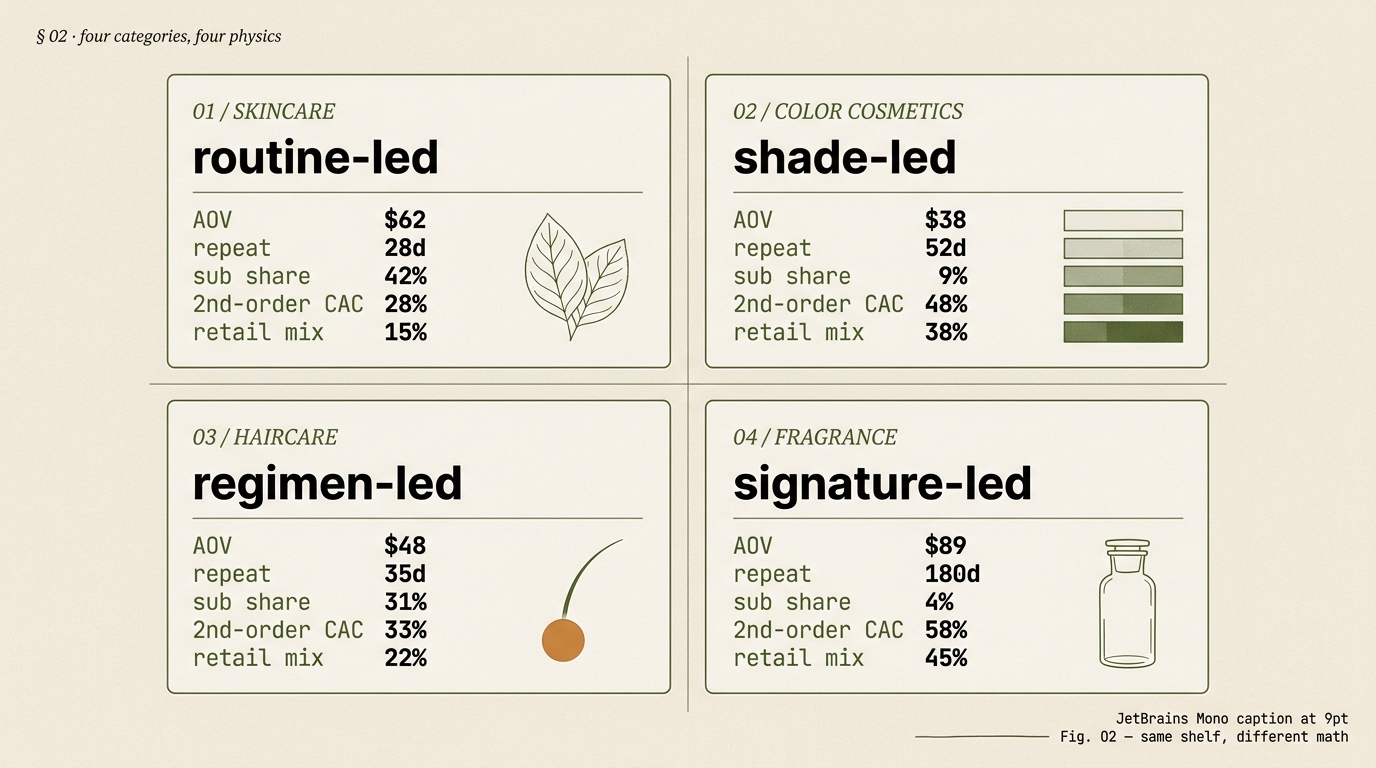
Skincare, colour cosmetics, haircare, and fragrance ship on the same Shopify stack and file under the same category on retail shelves. The commerce physics of each is completely different. A skincare playbook applied to fragrance will kill LTV; a fragrance playbook applied to skincare will miss retention. Read the numbers before you copy a strategy.

Editorial 2x2 grid of four beauty category plates showing commerce physics: skincare routine-led with AOV $62 and 28-day repeat window; color cosmetics shade-led with AOV $38 and 9% subscription share; haircare regimen-led with AOV $48 and 31% subscription share; fragrance signature-led with AOV $89 and 180-day repeat window.
Fig. 1 · four category physics · same shelf, four different commerce engines
01 · Skincare

Routine-led, replenishment-native.

Skincare buyers learn a sequence, not a product. Cleanser, serum, moisturiser, SPF. AOV compounds through routine builders, not individual hero SKUs. Subscription share should sit at 35-50%. Repeat window is the tightest of any beauty category. Brand education lives on the blog and the product page is carrying the whole funnel.

where brands lose it: skipping ingredient transparency, under-indexing on sets, hiding refills behind a discount wall
02 · Colour cosmetics

Shade-led, retail-heavy.

The single biggest commerce decision is shade matching. Foundation, concealer, lip, and brow live or die on a quiz plus swatch plus sampling mechanic. Subscription share stays in single digits; retail channel weight is the highest in beauty at 38% or more. The winners own their own shade language and syndicate it to Shopify, Sephora, and Ulta from a single source of truth.

where brands lose it: a plain variant picker for foundation, no undertone logic, catalog sync drift between channels
03 · Haircare

Regimen-led, texture-segmented.

Hair type is the axis everything pivots on. Curl pattern, density, porosity, chemical state. Buyers segment themselves by typology before they segment by brand. Subscription share sits around 31% for the strong brands; refill cadence tuned to bottle size matters more than price. The brands that win own a diagnostic quiz that doubles as an acquisition asset.

where brands lose it: no typology quiz, PDP copy that treats all hair the same, a regimen page buried three clicks deep
04 · Fragrance

Signature-led, sampling-first.

Fragrance cannot be smelled through a screen. Sampling is the entire acquisition mechanic. AOV is the highest in beauty at around $89, but the repeat window stretches past 180 days. Subscription share is in low single digits because the buyer does not want 30-day refills of perfume; they want a next-scent recommendation annually. Discovery sets, credit-back-on-full-size, and olfactory families drive the whole funnel.

where brands lose it: no sampling program, forcing a subscription model, generic scent descriptors, missing fragrance family taxonomy
§ 03 · the formulation stack

A beauty brand is built the way a serum is formulated.

Conversion first, because the product page has to actually close. AOV second, through routine and basket design. Retention third, because the second purchase is the whole business. LTV fourth, through refills and membership. Brand equity last, as the crown that compounds the four below it. Fourteen seconds, five layers, no shortcut.

Fig. 2 · formulation stack · conversion → AOV → retention → LTV → brand equity
§ 04 · the 2026 beauty commerce stack

An opinionated stack. Six picks, one shape.

Beauty brands fail more often from stack sprawl than from a bad product. Six categories, one pick per category, deep integration instead of shallow breadth. This is our 2026-Q2 default. We revisit the picks every six months.

  1. 01

    Commerce platform · Shopify Plus.

    Shopify Plus for brands above $3M ARR or with retail syndication needs, standard Shopify below that. Checkout Extensibility via Checkout UI Extensions for regulatory blocks and upsells. Shopify Markets for international catalogs.

    why this and not the others: only platform where checkout, subscription, reviews, and retail syndication coexist without a middleware tax
  2. 02

    Subscription · ReCharge or Stay AI.

    ReCharge for scale and deep Klaviyo integration. Stay AI for brands wanting AI-tuned cadence and churn prediction. Smartrr for members-club brand-forward models. The platform choice defines churn curve and LTV for two years out.

    picking wrong costs: 15-25% of LTV in year one, then compounding
  3. 03

    Email and SMS · Klaviyo + Attentive.

    Klaviyo as the system of record for customer data and email flows. Attentive or Postscript on SMS. The seven retention flows that should exist day one: welcome, abandoned cart, abandoned checkout, browse, post-purchase, replenishment, win-back. Each one tied to SKU-specific use windows for beauty.

    revenue-per-recipient targets: email $0.15+, SMS $0.80+
  4. 04

    Reviews and UGC · Okendo or Yotpo.

    Review density is the highest-impact PDP element in beauty after ingredient transparency. Okendo for clean beauty brands wanting attribute-level filtering (skin type, concern, undertone). Yotpo for brands wanting loyalty and reviews on one platform. Both syndicate to Google Shopping and Sephora.

    PDP density target: 120+ reviews per hero SKU before paid push
  5. 05

    Support · Gorgias.

    Gorgias with macros tuned for beauty-specific tickets: allergic reaction handoff, shade return credit, replenishment adjustment, subscription pause. The AI-assist layer cuts response time by 40% when the macro library is built right; it makes it worse when it is not.

    ticket-to-revenue tie: adverse event intake feeds the MoCRA log automatically
  6. 06

    Shipment tracking · Malomo.

    The post-purchase page is owned real estate and most brands ignore it. Malomo turns the shipment-tracking page into a branded touchpoint carrying routine education, sample code redemption, and referral hooks. 40% open rate on a transactional page is better than any email in the stack.

    why this is the last pick: it is the only pick you install last; the first five compound without it, none compound without them

Our stack is opinionated and it changes every six months. These are the picks we run for beauty brands in 2026-Q2.

§ 05 · MoCRA and the compliance reality

Compliance is now a platform feature, not a PDF.

MoCRA, the Modernization of Cosmetics Regulation Act, took effect in 2024. EU CPNP and UK SCPN have been active for years. Prop 65 affects every brand shipping into California. Compliance used to be a lawyer's folder; now it is a data model inside your Shopify catalog. Four artifacts every beauty brand needs to build into the storefront itself.

artifact 01 · ingredient source of truth

One list, rendered everywhere.

INCI names, concentrations where required, allergen flags. Stored as structured metafields in Shopify Admin API, rendered to the PDP, the Sephora feed, the Amazon catalog, and the EU CPNP notification file from the same source. One edit, four surfaces updated.

artifact 02 · claim scaffolding

Claims that map to substantiation.

Every marketing claim on the PDP ("reduces fine lines", "clinically proven", "dermatologist tested") carries a machine-readable reference ID that maps to a substantiation file in a shared drive. When the FTC or a retailer asks, the answer is a URL, not a scramble.

artifact 03 · adverse event intake

MoCRA-ready reporting.

Customer support macros in Gorgias route adverse event reports to a structured log with timestamp, product, lot number, and reaction detail. MoCRA requires the record; we build the intake so a human never has to remember the format.

artifact 04 · regional surface logic

Prop 65, CPNP, SCPN, one engine.

California orders show Prop 65 warning. EU orders carry CPNP-compliant ingredient disclosure. UK orders carry SCPN. All driven by geolocation at cart and per-product metafield flags, not by a separate store for every jurisdiction.

We are engineers and designers, not regulatory counsel. We build the workflow and the data model. Your lawyers sign off on the substance. The combination is what keeps the brand compliant at scale.

§ 06 · shade and routine matching

The variant picker is the wrong abstraction.

Beauty buyers do not pick a variant. They match a shade, a skin type, a hair texture, a scent family. A plain Shopify variant dropdown is the default and it is also the wrong interface. Replace it with one of three patterns depending on category. Conversion uplift runs 18 to 42% when the pattern matches the buying task.

  Quiz + swatch AR try-on Sampling-first
best for foundation, concealer, complex skincare routines lip, brow, blush, eye shadow fragrance, niche perfumery, hero-SKU skincare
core mechanic undertone and depth quiz feeding a filtered swatch grid YouCam, Perfect Corp, or Shopify AR overlay discovery set plus credit-back on full-size
conversion uplift (median) 28% 18% 42% on next full-size purchase
development effort 2-3 weeks, structured content rebuild 2 weeks plus asset prep 4-6 weeks plus fulfilment ops
retention hook abandoned-shade Klaviyo flow save the look, share to friend credit window drives second purchase
wrong when catalog under 12 shades total skincare or fragrance (the visual does not help) subscription-heavy models (the credit window collides)

We pick the pattern on the intro call by category, catalog size, and current PDP behaviour. Brands that try to run two patterns at once see both under-perform.

§ 07 · refill is the whole business

Tune cadence to product life, not to billing cycles.

Most beauty subscriptions break the same way. The brand picks a 30-day cadence because 30 days maps to monthly billing. The product runs out at day 45. The customer has 15 days of product sitting on the counter before the next box arrives. Skip rates go up, churn follows. Fix it by matching cadence to product-specific use windows, not to billing convenience.

lever 01

Cadence tuned to SKU.

A 50ml serum used twice daily lasts ~45 days. A 250ml shampoo lasts ~60 days. A 30ml toner lasts ~25 days. Each SKU gets its own refill window stored as a metafield. The subscription builder reads from there, not from a default.

lever 02

Skip, swap, pause, done.

Four controls, all self-service, all reachable in one click from the account page and the transactional email. Brands that hide these behind a support request see 2-3x the churn, every time.

lever 03

Membership over discount.

The 15% subscribe-and-save discount is table stakes. The thing that actually moves churn is membership: early access, sampling, birthday gifting, closed content, replenishment-by-text. Members churn at half the rate of pure discount subscribers.

lever 04

2nd-order CAC as the metric.

What does the second purchase cost? When 2nd-order CAC is a fraction of 1st-order CAC, retention is real. When it is similar, the brand is replacing, not retaining. This number sits on the CFO dashboard, not buried in the growth team's sheet.

Our target operating band for beauty subscriptions: skip rate under 20%, monthly churn under 4%, membership share above 30% of active subscribers within six months of launch.

§ 08 · TikTok Shop, Sephora, Ulta, Amazon

Four channels, one catalog.

A DTC beauty brand above $5M ARR is almost always also a retail brand and almost always also a TikTok Shop brand. Running four catalogs manually is how inventory breaks. Shopify stays the source of truth; the other three are downstream feeds with channel-specific overrides. Different pricing, different descriptions, different email programs, one catalog of record.

channel 01

DTC Shopify

source of truth

Full catalog, full pricing, full routine education. Where brand equity lives. Subscription and membership run here. Every other channel inherits from here.

for · owned relationship
channel 02

Sephora / Ulta

acquisition engine

Hero SKUs only. Retailer owns customer email. Your job is the BOPIS experience at shelf, the product data feed, and the separate email program for customers who found you through retail.

for · discoverability at scale
fastest growing
channel 03

TikTok Shop

content-commerce

Creator-led, affiliate-driven, shoppable-video first. Catalog sync from Shopify plus a creator roster and an in-video-purchase experience. Margins tight, volume real. The algorithm now does the acquisition math.

for · velocity plus new audience
channel 04

Amazon

search capture

Defensive listing for brand search and category search. A+ content, Brand Store, Subscribe and Save. Amazon Luxury Stores for premium brands. Not the flagship; a moat against resellers.

for · defending the brand name

Inventory allocation across four channels is the hardest operational problem in a scaling beauty brand. Our build includes the allocation logic so retail pulls and DTC demand do not collide.

§ 09 · the Clean Shelf Method

Named, ordered, built bottom-up.

Our proprietary operating method for DTC beauty brands. Five layers, run in this order, no shortcuts. The same thinking we ran on the Emani clean beauty build that took the brand from early traction to $2M MRR. Skipping a layer collapses the one above it.

  1. L1

    Conversion layer.

    The product page actually closes. Ingredient transparency rendered from a single metafield source. Claim scaffolding that maps copy to substantiation. Shade or routine matching UX replacing the plain variant picker. Review density at 120+ on hero SKUs before any paid acquisition push. Nothing above this layer works if the PDP leaks.

  2. L2

    AOV and basket layer.

    Routine builders, set mechanics, minimum-threshold gifting, "complete the routine" upsells in cart. Beauty AOV compounds through routine logic, not through stacking discount codes. Target AOV uplift of 18-30% on sets versus singles without any paid promotion.

  3. L3

    Retention layer.

    Post-purchase sampling, replenishment reminders tuned to use windows, the skin-quiz-or-hair-quiz-to-flow handoff. The second purchase is the whole business. Pure one-time buyers cost more to acquire than they return. Retention moves the math from survival to compounding.

  4. L4

    LTV and subscription layer.

    Refill subscriptions with SKU-tuned cadence, skip and swap controls, pause before cancel, and a membership tier sitting above the discount layer. The metric that matters is 2nd-order CAC, not LTV in isolation. When 2nd-order CAC is under 30% of 1st-order CAC, the brand is funding its own growth.

  5. L5

    Brand equity layer.

    The crown. When customers search the brand name more often than the category term, paid CAC drops structurally. Earned media, retail placement, organic search, and influencer gifting align under a single creative thesis. This is the last layer because it compounds slowest, and the hardest to fake because the four below it are measurable.

Any beauty brand is welcome to use the method. We ask only that it is named when described, because naming forces ordering, and ordering is the whole point.

§ 10 · the fit check

We turn down more beauty projects than we take.

Beauty is the category we run most. It is also the category where the wrong engagement costs both sides the most. Here is our honest filter before the intro call.

we're right for you if
  • Revenue floor: $50K per month, trending up
  • Contribution margin of 50% or better (beauty margins run high; if yours are below this, product cost is the problem, not growth)
  • Product-market fit verified via organic repeat-purchase behaviour
  • On Shopify or Shopify Plus (or willing to move)
  • A catalog of 12+ SKUs across at least one routine arc
  • Founder or brand director available for weekly working sessions
we're wrong for you if
  • ×Single-SKU launching into a crowded category (test channels cheap first)
  • ×Dropshipping or private-label catalogs (margin math does not fund the work)
  • ×Pre-MoCRA-aware brand with no willingness to invest in compliance
  • ×Looking for a rebrand-only engagement (we build operations, not decks)
  • ×Treats the agency as a task-taker rather than a strategic partner
  • ×Claims or ingredients that cannot be substantiated on request
what we commit

You own the Shopify store, the Klaviyo account, the ReCharge instance, the Okendo review library, the Gorgias macros, the catalog metafields, the compliance data model, and every piece of creative shipped. On day one and on exit. 30-day pause clause, no exit fee, no proprietary tech you would lose access to.

§ 11 · four shapes of engagement

Pick the shape your stage needs.

We confirm fit on the intro call and send a scoped quote within 48 hours. Scope moves price; the conversation stays the same.

diagnose

Beauty brand audit

2 weeks

Brand litmus test scoring, MoCRA readiness, shade and routine UX audit, subscription architecture review, retail dual-channel math, 90-day priority roadmap. Deliverable is yours whether you engage further or not.

for · founders asking hard questions
most picked
build

Clean Shelf build

10-16 weeks

Shopify Plus build using the Clean Shelf Method. PDP conversion layer, AOV architecture, retention and subscription flows, LTV instrumentation, brand equity asset system. Ready for MoCRA and EU CPNP at launch.

for · brands ready to scale operations
retrofit

Subscription + refill

6-8 weeks

ReCharge, Smartrr, or Stay AI architecture, refill cadence design, skip and swap flows, membership tier model, churn instrumentation. Retrofit on an existing Shopify store.

for · retention math that is not compounding
partner

Full partnership

12 months

Dedicated pod covering Shopify build, compliance operations, Klaviyo and Attentive flows, retail syndication, TikTok Shop integration, ongoing CRO. Sits alongside in-house creative.

for · $5M-$50M brands scaling multi-channel

Quotes sent within 48 hours of an intro call. Ad spend is billed by you direct to the platforms; we never hold media budgets on behalf of a brand.

§ 12 · questions

Eight answers.

What does a beauty ecommerce agency actually do?

A beauty ecommerce agency builds and runs the operating stack for a cosmetics, skincare, haircare, or fragrance brand selling direct to consumer. That means Shopify or Shopify Plus storefront engineering, product page conversion design, shade and routine matching UX, subscription and refill architecture, MoCRA and EU CPNP compliance artifacts, Klaviyo and Attentive retention flows, review and UGC syndication, retail dual-channel integration with Sephora or Ulta, and TikTok Shop operations. The good ones treat all of that as one stack, not seven vendors.

What is the Clean Shelf Method?

Our five-layer operating model for DTC beauty brands. Conversion layer first: the product page has to actually close. AOV and basket layer second: routine builders and set mechanics, not discount stacking. Retention layer third: post-purchase sampling and replenishment tuned to use windows. LTV and subscription layer fourth: refill mechanics with skip and swap. Brand equity layer last: the crown that compounds when the brand becomes a search term in its own right. Built bottom-up because skipping a layer collapses the one above it.

How much does a beauty ecommerce agency cost?

Pricing is scoped to engagement shape. Beauty brand audit: 2 weeks. Clean Shelf Method build on Shopify Plus: 10-16 weeks. Subscription and refill engagement as a retrofit: 6-8 weeks. Full beauty partnership: 12 months with a dedicated pod. Book a 30-minute call and we send a scoped quote within 48 hours. Scope moves price, not the conversation. We never quote off a category alone.

Do you handle MoCRA compliance for cosmetics brands selling in the US?

Yes. MoCRA, the Modernization of Cosmetics Regulation Act, requires US cosmetics brands to register facilities and products with the FDA, maintain adverse event records, and surface substantiated claims. Our build process includes a compliance layer: ingredient list rendering from a single source of truth, adverse event reporting handoff, claim scaffolding that maps marketing copy to substantiation files, Prop 65 warning logic for California orders, and parallel EU CPNP and UK SCPN artifacts for international catalogs. We are engineers and designers, not lawyers, so we build the workflow and your regulatory counsel signs off.

Can you build shade matching for color cosmetics and foundation brands?

Yes. Shade matching is one of the highest-impact UX decisions a color cosmetics brand makes. Our approach layers three patterns: a shade finder quiz tied to undertone and depth variables, a visual swatch grid with skin tone representation across the full Fitzpatrick range, and a try-on or AR layer using YouCam, Perfect Corp, or native Shopify AR where the catalog supports it. The quiz output feeds Klaviyo for abandoned-shade flows and sampling programs. Conversion uplift ranges from 18 to 42 percent when shade matching replaces a plain variant picker.

How do refill subscriptions work for a skincare or haircare brand?

Refills are the retention math of beauty. A 50ml serum used twice daily lasts about 45 days; shipping it every 30 days causes churn, every 60 days causes missed revenue. We tune refill cadence to SKU-specific use windows, build skip, swap, and pause mechanics via ReCharge, Smartrr, or Stay AI, and layer a membership tier on top so the subscription becomes a club, not a discount. Skip rates under 20 percent and churn under 4 percent monthly are our targets. We instrument both in Shopify and in the subscription platform so the numbers match.

We sell on Sephora, Ulta, and Amazon as well as our own site. Do you handle retail syndication?

Yes. Retail and marketplace dual-channel is now the rule for any beauty brand above a certain scale. We run product data syndication from your Shopify catalog as the source of truth out to Sephora SKU feeds, Ulta portal uploads, Amazon Vendor or Seller catalogs, and increasingly TikTok Shop. We also handle the inventory allocation logic so retail pulls and DTC sales do not collide, and we set up the separate email programs retail customers need because their purchase context is different from your DTC shoppers.

When is a brand ready for Shopify Plus versus staying on standard Shopify?

Three triggers move a brand to Shopify Plus. First, checkout customisation needs: upsells, membership gating, or regulatory blocks that standard checkout cannot reach. Second, international expansion: Shopify Markets and Markets Pro are easier to run at Plus. Third, throughput and apps: brands running ReCharge plus Klaviyo plus Okendo plus Gorgias plus Attentive often hit standard Shopify ceilings around the $3M to $5M annual mark. We run the fit assessment against those three triggers on the intro call, not against revenue alone.

Start with a brand audit.

A 30-minute call to run the brand litmus test on your numbers. You leave knowing which of the four engagement shapes fits your stage. We follow up with a scoped quote within 48 hours.