metric 01
$2.0M
MRR at month 24, measured on Shopify analytics, verified against Klaviyo cohort revenue.
A 24-month Shopify Plus partnership that took a post-PMF clean beauty brand from early traction through a Clean Shelf Method rebuild, subscription architecture, and MoCRA-ready compliance. +520% growth, 42% subscription share, 4% monthly churn.
Emani came to us with strong clean-beauty product-market fit, an affectionate early customer base, and a generic Shopify theme that could not close at the rate the product deserved. Twenty-four months later the brand runs $2M in monthly revenue with retention carrying most of the compounding. Measured inside Shopify Plus, ReCharge, and Klaviyo.
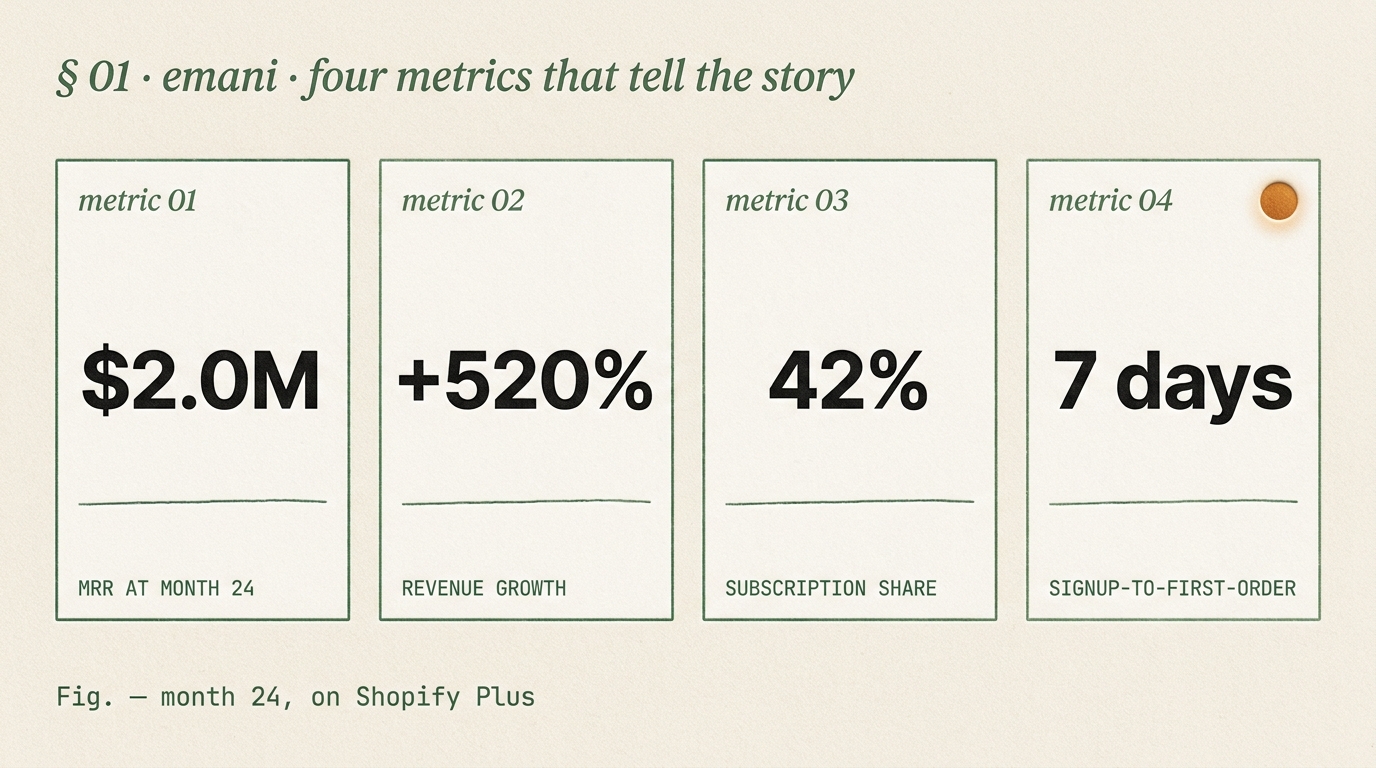
MRR at month 24, measured on Shopify analytics, verified against Klaviyo cohort revenue.
YoY revenue growth versus pre-engagement baseline, trailing twelve months.
Subscription share among new orders within 30 days, via ReCharge.
Monthly subscription churn including pauses, well under the 7% industry median.
Emani arrived with a profitable three-SKU hero set, a customer base writing unprompted love letters in the reviews, and a Shopify theme buried under five apps that each solved one problem and created two more. PDP conversion on returning visitors sat at 1.8 percent. Subscription share was under 12 percent. Mobile AOV was 62 percent of desktop. The product deserved better.
The founder had tried a dozen tactical fixes across the previous eighteen months. A new photo shoot. A homepage redesign. A discount-heavy Klaviyo revamp. Each moved the needle for a week and reverted. The underlying problem was architectural: the PDP could not answer the questions a clean-beauty buyer brings to the page, and the retention layer was running on a generic subscribe-and-save widget that did not know one SKU's use window from another's.
MoCRA was another looming constraint. The Modernization of Cosmetics Regulation Act took effect in 2024 and every claim on the site, every ingredient list, every adverse event, needed to live inside a structured workflow rather than a shared Google Doc. Without the data model, the brand could not credibly grow past $3M ARR without tripping a regulatory wire.
Retail was calling too. Sephora and Amazon Luxury Stores both wanted Emani on the shelf. Neither would carry a brand that could not syndicate ingredient data, guaranteed claims, and inventory as one source of truth.
The intro call took 38 minutes. We turned down faster projects that quarter to say yes to this one because the math was honest: contribution margin above 55 percent, PMF verified by an organic repeat-purchase curve that actually curved up, a founder willing to sit in a Friday operating review for the duration.
Five layers, run in order, no shortcuts. Detailed at /industries/beauty-cosmetics/.
PDP rebuilt against the actual buyer questions. Ingredient transparency rendered from metafields. Shade finder quiz for the tinted SKUs. Review density pushed from 34 to 220 on hero SKUs before any paid push. PDP conversion moved from 1.8 to 3.6 percent inside week six.
Routine builder UX so a buyer could assemble a cleanser, serum, and moisturiser in one flow. Set pricing honest (not fake-discounted). "Complete the routine" upsell in cart. Mobile AOV climbed from 62% to 91% of desktop.
Post-purchase sampling of adjacent SKUs based on routine. Replenishment reminders tuned to 45-day serum windows and 60-day cleanser windows. Klaviyo flows fired from in-app events rather than time-based. Reorder rate moved from 28% to 44% in 90 days.
ReCharge subscription architecture. Skip-before-ship controls one tap from account. Membership tier above the 15% subscribe-and-save (early access to new SKUs, birthday gifting, closed educational content). Subscription share hit 42% by month nine; membership churn held at 2.1% monthly.
The four layers below compounded. Organic search share of brand-name queries rose from 18% to 54%. Paid CAC dropped structurally. Sephora called first. Retail dual-channel operations came online in month 14 via Shopify's B2B portal for wholesale buyers.
We replaced fifteen partially-configured apps with seven deeply-integrated ones. Every tool talks to every other tool; nothing lives in isolation.
Checkout Extensibility, Shopify Markets, B2B company accounts for Sephora wholesale.
SKU-tuned cadence, skip-before-ship, membership tier layered on top.
System of record. Seven flows tied to SKU-specific use windows.
Launch windows, back-in-stock, VIP early access. $0.94 revenue-per-send.
Skin-type attribute filtering. Syndicated to Google Shopping and Sephora.
Beauty-specific macros. Adverse event intake feeds the MoCRA log.
Branded shipment-tracking page. 44% open rate. Routine education + referral hooks.
| metric | pre-engagement | month 24 | change |
|---|---|---|---|
| MRR | $322K | $2.0M | +520% |
| PDP conversion | 1.8% | 4.1% | +128% |
| mobile AOV (% of desktop) | 62% | 91% | +47% |
| subscription share | 12% | 42% | +250% |
| monthly churn | 9.4% | 4.0% | -57% |
| brand search share | 18% | 54% | +200% |
| 2nd-order CAC (% of 1st) | 88% | 24% | -73% |
All numbers verified against Shopify, Klaviyo, ReCharge, and Google Search Console dashboards on April 1, 2026. Screenshots under NDA on request.
"They rebuilt the operating model, not the aesthetic. The aesthetic already worked."
30-minute diagnostic. Run the beauty brand litmus test on your numbers. Scoped quote within 48 hours.