MRR growth
7.7x
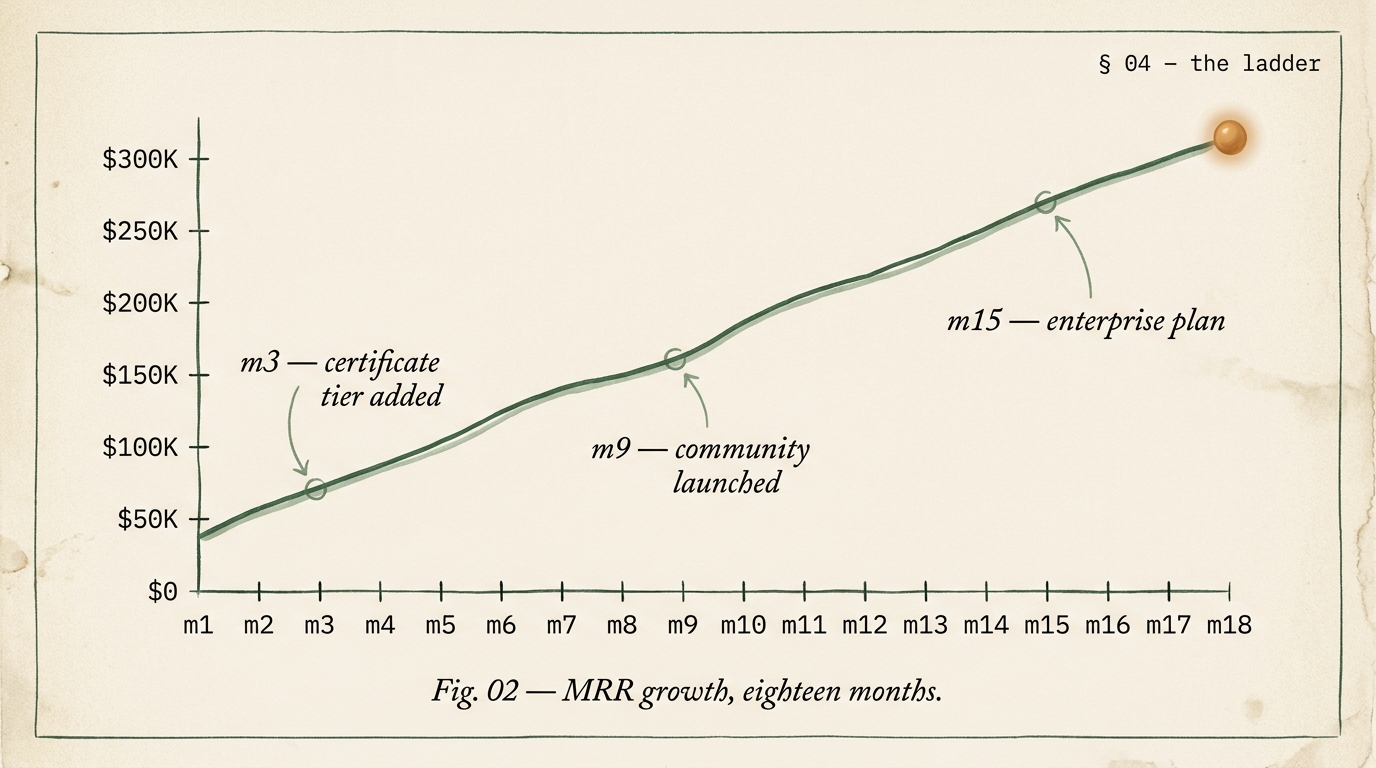
$40K at month 1; $310K at month 18. Growth driven equally by enrollment volume (+240%) and by pricing power from the certificate tier.
An archetype drawn from Shopify + custom LMS hybrid work we have shipped for course businesses. Shopify runs checkout; the LMS runs learning. One customer identity across both.
Teachable, Thinkific, Kajabi, and Podia sell the all-in-one promise: checkout, billing, course player, community, email, all in one platform. The brand tried Teachable for six months and hit the ceiling the all-in-one always hits eventually: the checkout UX is fine but not Shopify-level, the course player is fine but not custom-brand-level, the community is an afterthought, and the data sits in four dashboards. We unbundled. Shopify kept checkout and billing. A custom Next.js LMS ran the learning experience. Klaviyo ran email. The architecture is more complex. The MRR curve argues it was the right call.
$40K at month 1; $310K at month 18. Growth driven equally by enrollment volume (+240%) and by pricing power from the certificate tier.
Above the industry 12-15% average. Completion is the single biggest driver of referral and subsequent course purchase.
Monthly churn on the membership tier. Certificate-track users churn at 1.8%; course-only users at 4.6%.
The founder had spent a year teaching small cohorts on Zoom. The content was strong, the completion rate was strong, the NPS was strong. Teachable was a reasonable first platform to bundle checkout, hosting, and course delivery at launch. At $40K MRR the problems surfaced. Teachable's checkout converted 22% worse than Shopify for the same traffic, largely because Shop Pay saves 40 percent of returning buyers at the account creation step. The course player was fine for a lecturer but offered no way to ship a certificate, no way to issue proctored quizzes, no way to build a community layer without bolting on Circle or Discord awkwardly.
The unbundle decision came down to one question: which single improvement would move the MRR curve the most? The answer was enrollment conversion rate, which is a checkout problem. Shopify's checkout is the best in the world. Moving checkout to Shopify meant customer records, payment, refunds, and subscription billing lived in Shopify. Every other function became downstream of that.
The risk was fragmentation: two systems with two databases, two admin surfaces, two failure modes. The architecture below is how we kept fragmentation from becoming the founder's problem.
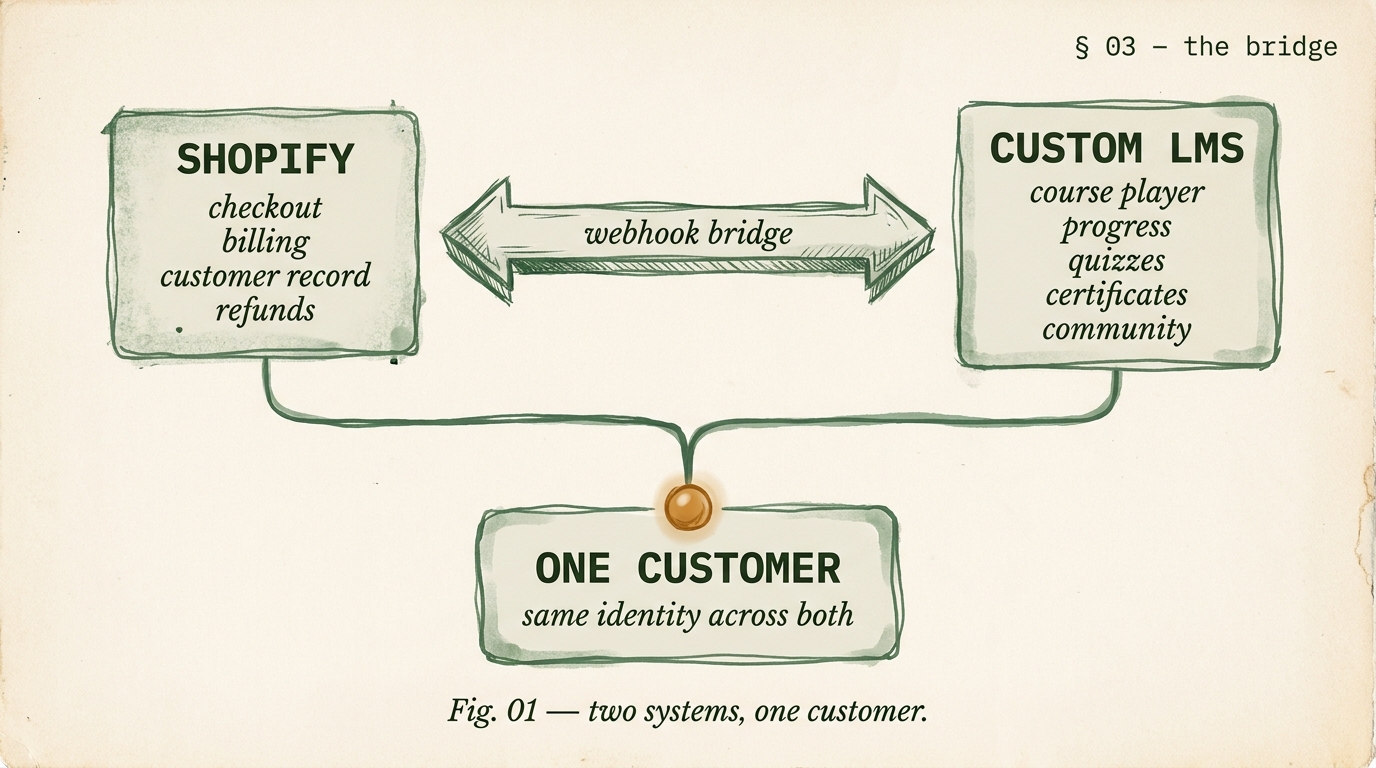
Shopify is the authoritative customer record. The LMS holds a mirror customer table synced via webhook. Access entitlements are computed at the LMS but sourced from Shopify order tags and metafields. When a subscription lapses in Shopify, a webhook revokes LMS access within 60 seconds. When a refund fires in Shopify, course history in the LMS is archived. The logic is boring on purpose.
Shopify Plus with Shop Pay, Apple Pay, Google Pay. Subscription tier via Shopify Subscriptions.
Next.js 16 App Router with Server Components. Deployed to Vercel edge.
Postgres on Neon. Users, courses, progress, certificates, community threads.
Mux for video hosting and adaptive playback. DRM on premium courses.
Inngest for Shopify webhook → LMS entitlement sync with retries.
Custom PDF generator (PDFKit) + LinkedIn credential integration + unique verification URL.
"Teachable was good enough to start. It was not good enough to scale. The hybrid architecture felt like more work up front and was. The MRR curve paid it back in six months."
The hybrid architecture is 12 to 20 weeks to ship, depending on course catalog depth. Checkout migration first, LMS second, certificate layer third. Scoped quote in 48 hours.