metric 01
55%
Self-serve share, up from 18% on Magento.
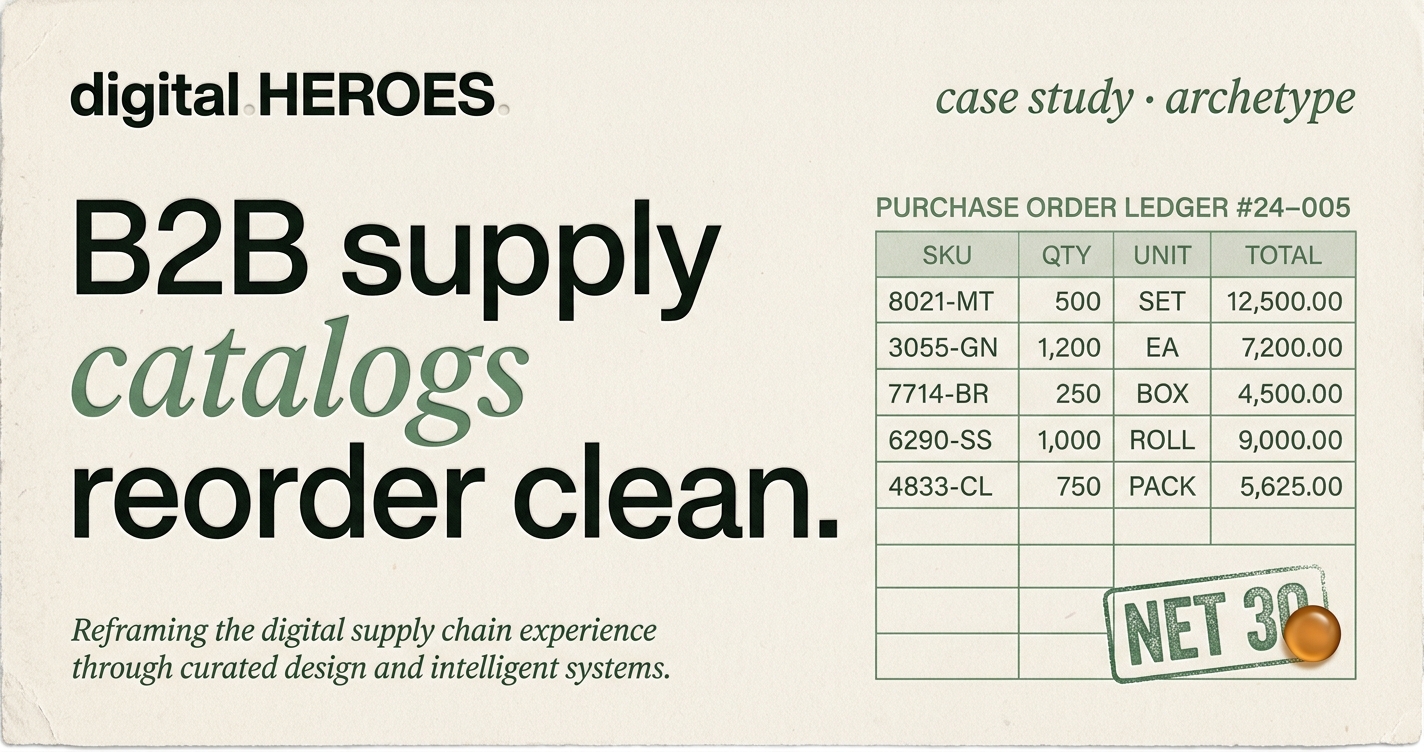
Industry archetype drawn from patterns across multiple B2B and wholesale brands we have migrated through the Catalog Method. 55% self-serve share, order cycle cut to 18 hours, 4.2x reorder compounding.
This archetype reflects patterns across multiple B2B industrial and wholesale brands we have migrated through the Catalog Method. Buyer self-serve share tripled. Measured on Shopify Plus B2B + NetSuite via Celigo.
Self-serve share, up from 18% on Magento.
Order-to-confirmation cycle, down from 72h.
Reorder GMV vs first-order GMV, trailing 12 months.
NetSuite-to-Shopify sync lag on inventory and pricing.
B2B industrial brands fitting this archetype arrive with a decade of Magento 2 Open Source history, a NetSuite implementation that runs the business properly, and a frustrated leadership team paying $18-30K annually on Magento hosting plus three-developer retainer to keep the storefront upright. Self-serve share hovers around 18 percent because buyers default to emailing the rep; approval workflows are bolted on via custom development and break on every upgrade.
Order cycle from buyer-submit to order-confirmed runs 48-96 hours on Magento operations because the ERP sync is batched overnight and approval emails route through a plugin that sends them to the wrong inbox half the time. Enterprise buyers tolerate it because their alternative is calling; they do not like it.
Mobile experience is the quiet killer. B2B buyers increasingly reorder from phones during site visits or between meetings. Magento 2 mobile performance on the brand's Adobe Commerce Open Source hosting typically scores 23-38 on PageSpeed Insights. The Shopify Plus equivalent scores 72-86 out of the box.
Mapped existing Magento B2B customer records to Shopify company accounts: company, locations, users, roles. 847 companies, 2,100 users migrated.
Gold/silver/bronze tier structure rebuilt on Shopify B2B. Contract pricing per account migrated from Magento price lists. Volume breaks configured per SKU family.
Celigo iPaaS connecting NetSuite to Shopify for real-time inventory, pricing, credit limits, and order writeback. Sync lag tuned under 15 minutes.
Threshold-driven routing per company. Klaviyo transactional emails plus Slack notifications for approvers. Reject-with-reason flow.
Reorder-from-history, par-level reminders, scheduled POs, quick-order-by-SKU paste. The second-order engine that compounds B2B growth.
Buyer segment by segment, not big-bang. Top-20 accounts first (with hand-holding), next-200 second, remainder third.
Company accounts, tier pricing, approval workflows native.
System of record. Contract pricing. Credit limits. Order history.
Real-time NetSuite-Shopify sync. Battle-tested B2B connector.
NET-30 underwriting for new accounts. Direct ERP for established.
Approval-workflow transactional emails. Reorder reminders.
B2B ticket macros: quote requests, credit questions, order adjustments.
"We cut two developer seats and added 240 new accounts in the first year."
30-minute audit. Migration fit, ERP readiness, cutover risk. Scoped quote within 48 hours.