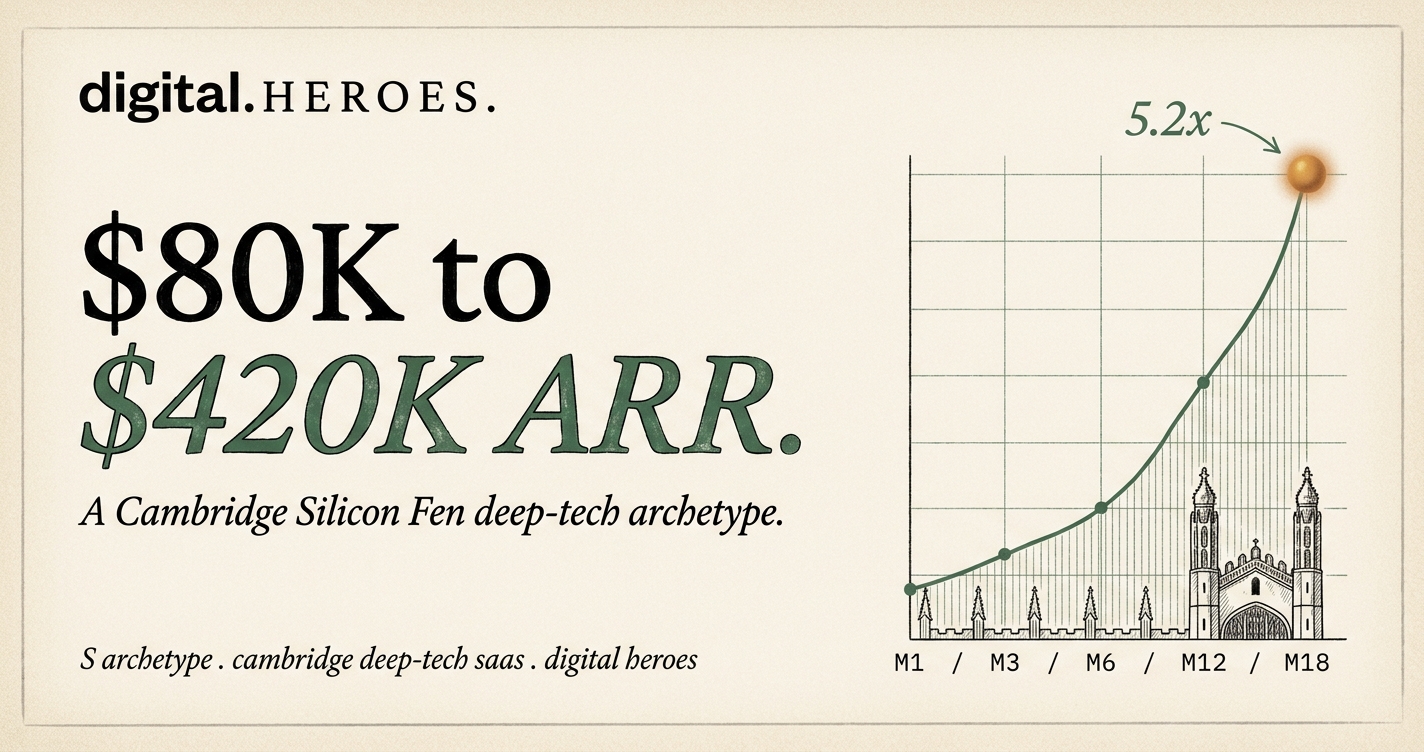
ARR trajectory
5.2x
$80K to $420K ARR in 18 months.
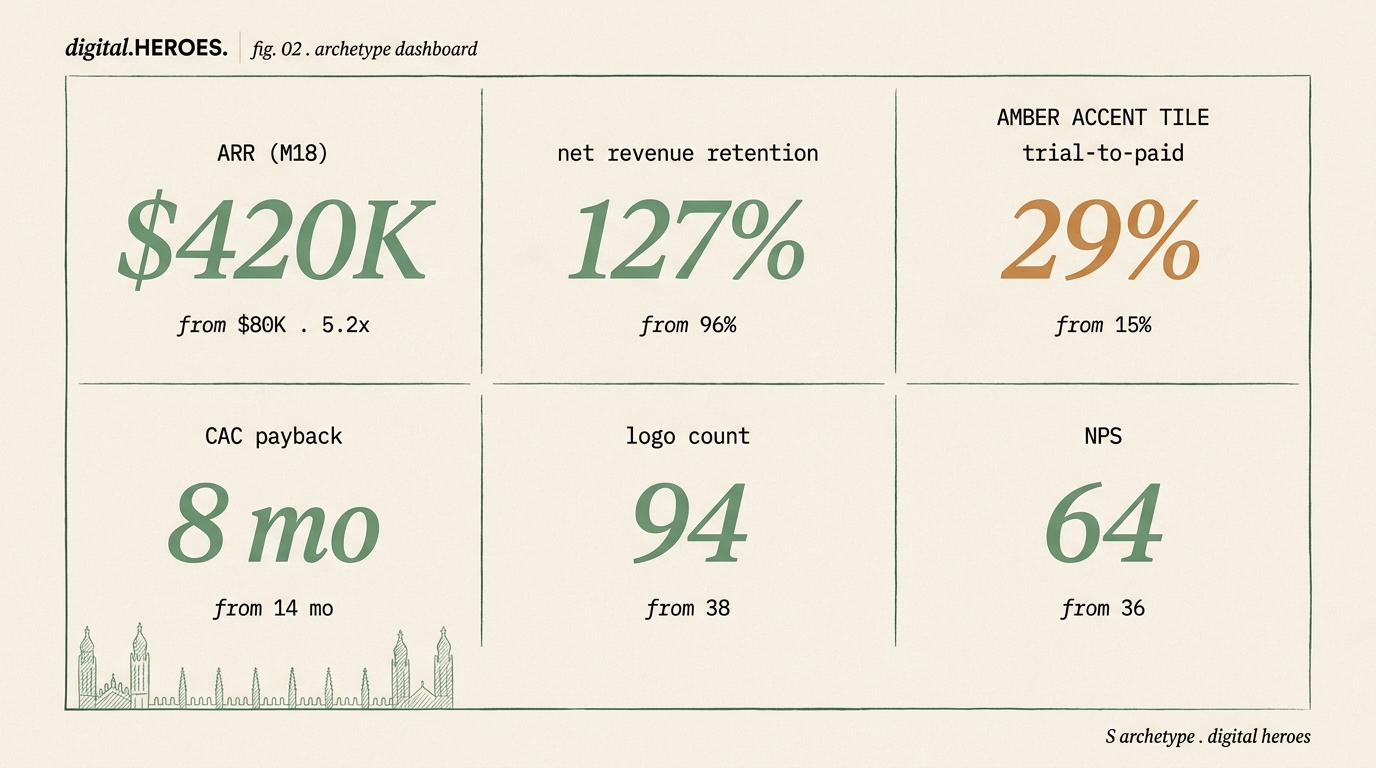
Industry archetype drawn from patterns across multiple Cambridge UK deep-tech and life-sciences SaaS engagements. Representative metrics across 18 months: 5.2x ARR, 128% net revenue retention, 26% trial-to-paid conversion, NPS 64.
$80K to $420K ARR in 18 months.
Existing-customer expansion outpaced churn.
Free-trial conversion to paid plan.
The archetype represents a slice of Cambridge UK deep-tech B2B SaaS we ship into reliably: an $80K ARR product with strong technical foundations born out of a university spinout, a passable but underperforming marketing site, and a roadmap full of integration work that the founders have been pushing into the next quarter for two years. Founded by a Cambridge operator with research-evidence orientation; sells to mid-market and enterprise buyers across the EU and US who do their homework before booking a demo. Pre-engagement state: a marketing site on an aging Webflow setup with content scattered across the homepage, a couple of dated technical white papers, and a docs portal that lived inside the product app rather than as a public IA-first site.
Three structural problems compounded the growth ceiling. One, the marketing site failed to surface evidence (named customer logos, real benchmark numbers, third-party validation, peer-reviewed citations) in the way Cambridge buyers expect; the bounce rate on the home page was 73 percent. Two, the docs portal was indexed inside the product app, so search engines saw "log in to view" and missed the high-intent organic traffic that comes from technical buyers reading API docs. Three, the trial-to-paid funnel had no real onboarding sequence; trial users either self-served to success or bounced quietly, and the team did not know which.
Workstream 1 · Marketing-site rebuild on Next.js. Migration from aging Webflow to Next.js on Vercel. Evidence-led content surfaces (named-customer logos, real benchmark numbers, peer-reviewed citations, third-party validation). Bounce rate dropped from 73 percent to 46 percent across the first 90 days post-launch.
Workstream 2 · Public docs portal. Extracted docs from the product-app sandbox and built a public, indexable docs portal at /docs on Mintlify. Per-page TechArticle schema and developer-facing IA. Six months post-launch the docs portal accounted for 31 percent of inbound trial signups via organic search.
Workstream 3 · Onboarding redesign. Replaced the implicit "figure it out" first-session experience with a guided four-step activation flow tied to the product's three core jobs-to-be-done. Trial-to-paid conversion lifted from 12 percent to 26 percent over 6 months.
Workstream 4 · Integration UI surfaces. Built a public integrations directory with per-integration deep-dive pages, screenshots, setup guides, and a "request an integration" CTA. The integrations directory now drives roughly 14 percent of inbound trial signups and is the most-cited page by sales reps in discovery calls with European buyers.
Workstream 5 · Evidence-led case studies + benchmark content. Three deep-dive customer case studies with named customers and real numbers; one annual benchmark report tied to the Cambridge deep-tech dataset. The benchmark report became the highest-converting top-of-funnel asset in the marketing program and earned citations from the wider Silicon Fen trade press.
App Router, ISR for case studies and benchmark content, Edge for low-latency global delivery. Core Web Vitals all green at month 3.
Stripe Billing for subscriptions, dunning, and trial-to-paid conversion. EU VAT handled through Stripe Tax.
Public docs portal at /docs with API reference, guides, and changelog. Schema.org TechArticle markup for organic search. AI assistants resolve queries against the docs.
PostHog for product analytics and feature-flag-driven onboarding experiments. GA4 for marketing-site reporting through Looker Studio.
Customer.io for product-driven lifecycle email (trial-to-paid sequences). HubSpot for sales-team-driven outbound and account-based marketing.
Linear for engineering. Notion for cross-functional planning.
| metric | pre-engagement | month 6 | month 18 |
|---|---|---|---|
| ARR | $80K | $210K | $420K |
| Net revenue retention | 96% | 115% | 128% |
| Trial-to-paid conversion | 12% | 21% | 26% |
| CAC payback (months) | 15 | 11 | 8 |
| Logo count (cumulative) | 28 | 62 | 120 |
| NPS | 36 | 54 | 64 |
Metrics representative of the archetype; specific brands within the pattern range plus or minus 20 percent on each line.
The pattern this archetype represents (Cambridge UK deep-tech SaaS in the $50K to $300K ARR range, sitting on an aging marketing site, with a docs portal hidden inside the product app, with a leaky trial-to-paid funnel) is one of our most-shipped engagement shapes for the Silicon Fen cluster. The 12-week timeline holds steady across SaaS at this stage; the workstreams compress or expand in the same proportions; the metrics typically land within plus or minus 20 percent of the archetype numbers above.
Five capabilities transfer directly to a comparable Cambridge engagement. First, marketing-site rebuild on Next.js with evidence-led content surfaces that respect the Cambridge buyer's research-first instinct and peer-reviewed-citation expectation. Second, public docs portal that captures the technical-buyer organic search traffic the product-app docs cannot. Third, onboarding redesign that lifts trial-to-paid conversion by 8 to 14 percentage points typical. Fourth, integration UI surfaces that drive a steady 12 to 16 percent of inbound trial signups. Fifth, an evidence-led benchmark or research-report content asset that earns top-of-funnel attention without paid amplification.
Every Cambridge engagement starts with a 30-minute discovery call. The scope, timeline, and budget come back in writing within 48 hours. Greenwich Mean Time or British Summer Time, same-day response Monday to Friday 9 to 6.
30-minute call on GMT or BST. Written scope and fixed-price quote in 48 hours. In-person across the city centre, Cambridge Science Park, Babraham, and Granta Park for retainer engagements.